This product may be covered by one or more trade secrets, and pending or issued patents and trademarks. For a listing of our registered intellectual property, See Bluestreak Patent Information..
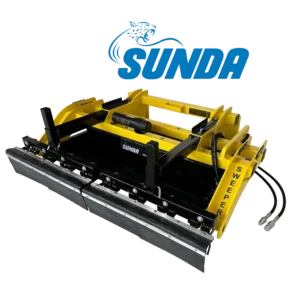
The Sunda Ball Mill Abrasive Clean Up Magnet is built for skid steers / track loaders to enable you to pick up steel balls used in ball milling and any other type of ferrous debris in an efficient manner. The Sunda has a 12” W x 11” H x 48” L permanently charged ceramic magnet assembly that allows the Sunda to pick up a 2.5” 8 penny nail from 16” off the ground. This magnetic power is necessary to pick up metal balls that are used to crush rocks in ball mills.
The Sunda can pick up steel balls from uneven surfaces where it would be impossible to scoop the balls with a bucket and would normally necessitate using a shovel and broom to clean up.When it’s time to drop off the collected metal from the magnet, the Sunda uses a ram powered by the skid steer / track loader’s auxiliary hydraulics to press the 12-gauge stainless steel debris pan away from the magnet housing, separating the debris from the magnetic field causing it to drop away from the magnet.
A Debris Digging Rake comes standard on the Sunda and helps to dislodge debris that may be embedded in the ground. The 3/8” spring teeth dig into hard surfaces to groom the area and kick up any steel that may be stuck in the ground so that the magnet can catch it. Rubber stone guards are equipped to prevent any flying stones from causing damage to anything around the Sunda.
$25,899.99
See Pricing For All Models Below

$25,899.99
| Sunda Series | Sunda 74 |
|---|---|
| SKU | SU49 |
| Maximum Lifting Height | 16” |
| Sweeper Weight | 1922 lbs |
| Shipping Weight | 2035 lbs |
| Sweeper Width | 49” |
| Sweeping Height Adjustment | Yes, continuous with lift arms |
| Sweeper Wheel Type | N/A |
| Clean Off Method | Hydraulic Flip Down |
| Terrain Surface | All Terrain |
| Pricing Range | $$25,899.99 |
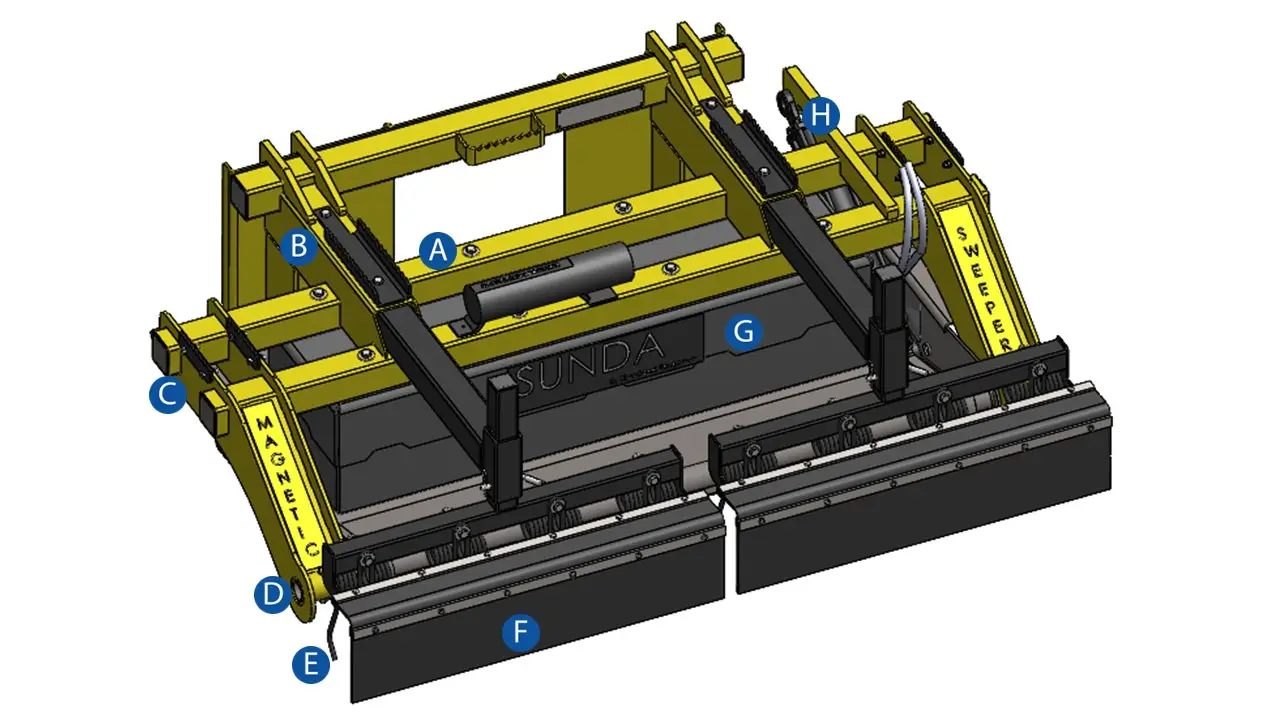
A: 3” x 3” x 0.1875” (3/16”) steel tube
B: 4” x 6” x 0.1875” (3/16”) steel tube sections
C: 0.375” (3/8”) thick steel end plates
D: 1.9” diameter steel pivot rod
E: 8x 0.375” (3/8”) thick steel Debris Digging Rake springs
F: Heavy duty rubber stone guard
G: Steel / stainless steel magnet assembly
H: 2” bore hydraulic cylinder
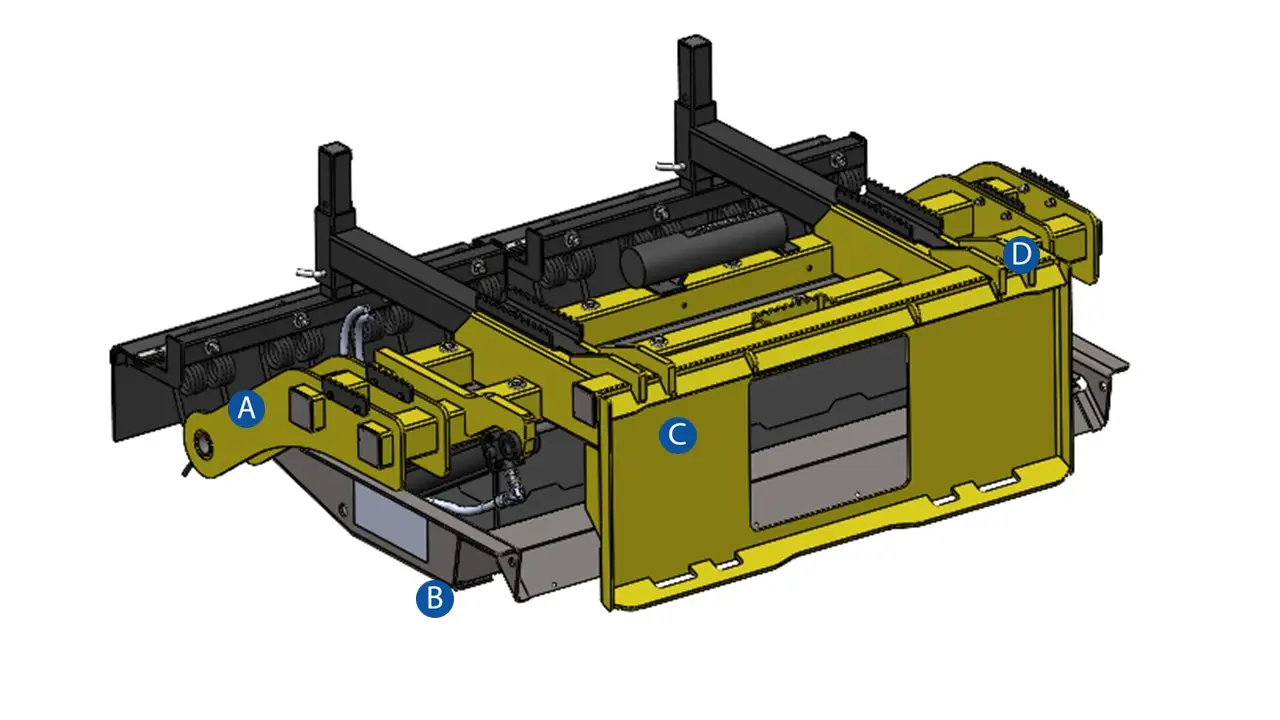
A: 0.250” (1/4”) thick steel end plates
B: 12 Gauge 0.104” thick 304 stainless steel debris tray
C: Heavy duty universal skid steer attachment plate welded (not bolted) on.
D: 0.625” (5/8”) thick steel reinforced attachments to top of attachment plate (4pcs)
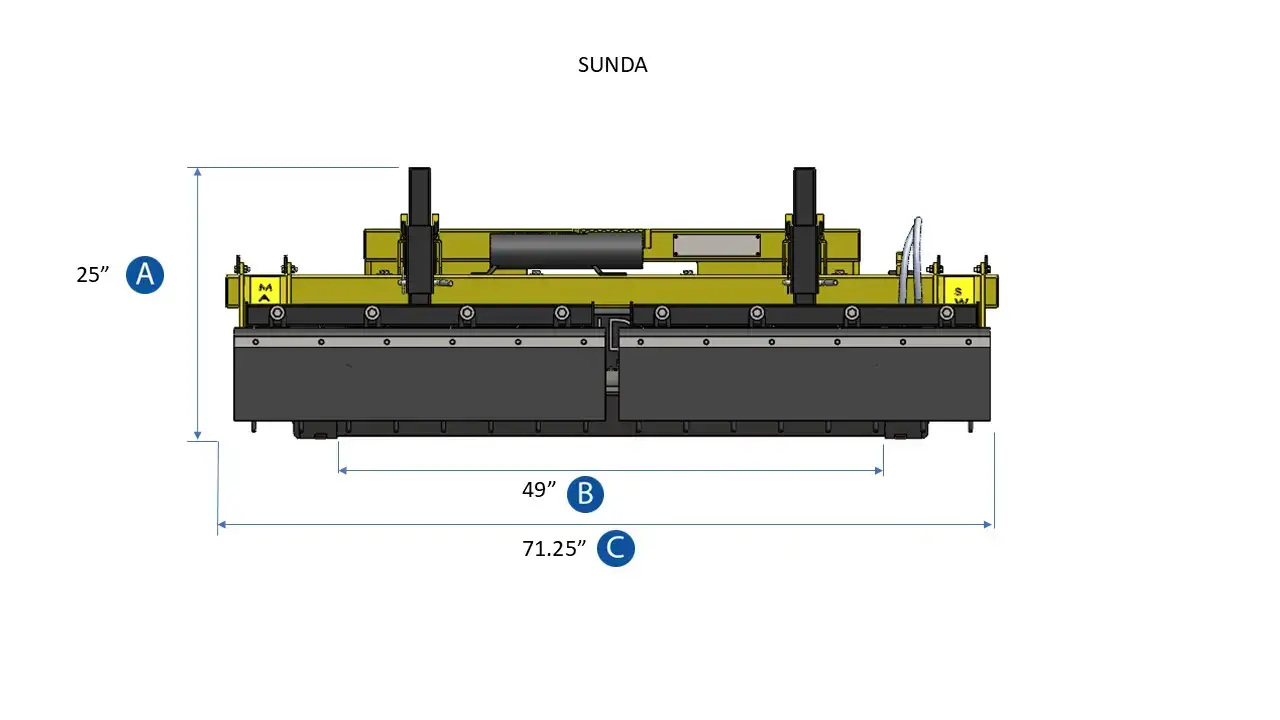
Sunda Dimensions Front View
A: Rake in upward position
B: Magnet width
C: Total width
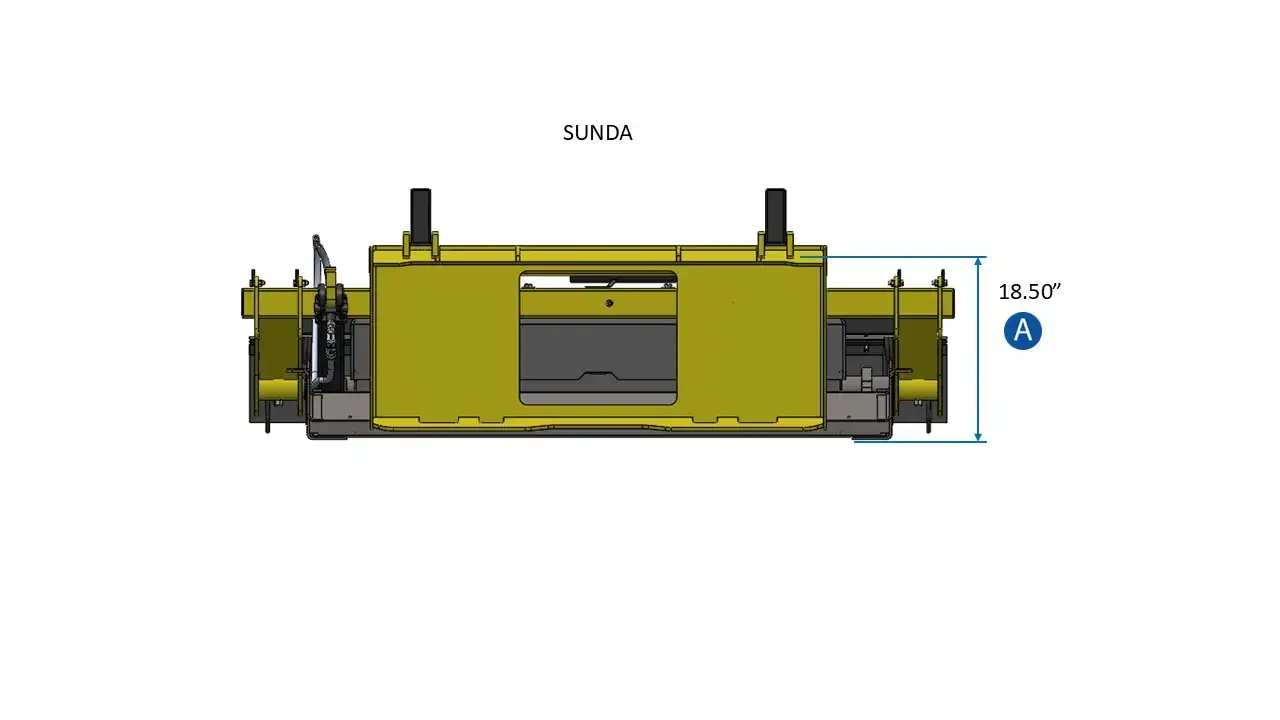
Sunda Dimensions Back View
A: Inside of connector plate to bottom of sweeper
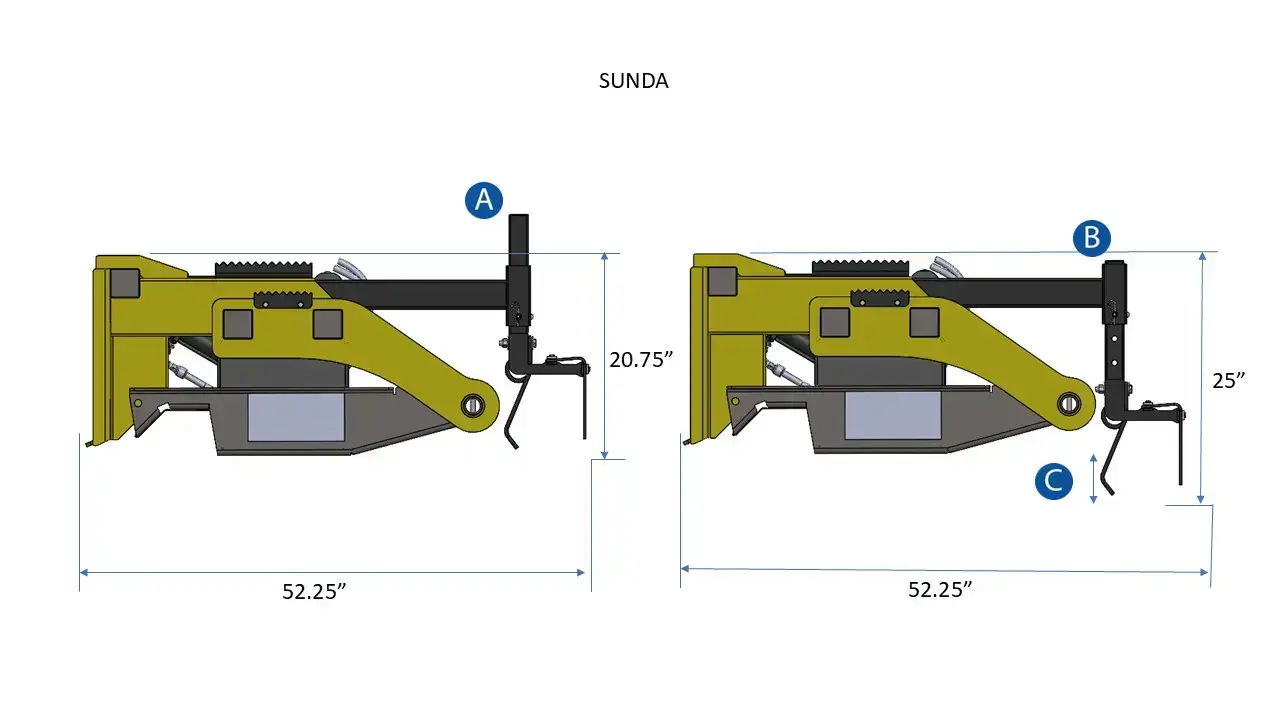
Sunda Dimensions Side View
A: Debris Digging Rake (DDR) in upward position
B: Debris Digging Rake (DDR) in downward Position
C: 2.5” and 5” DDR depth settings
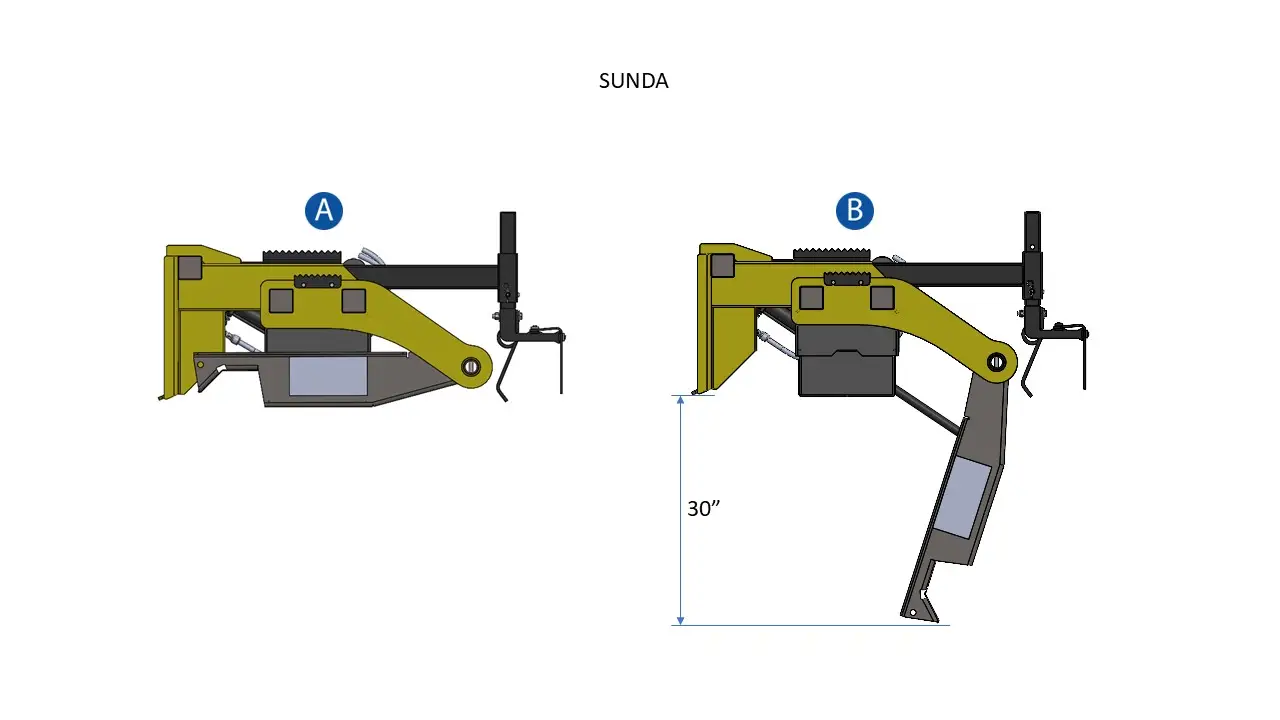
Sunda Dimensions Side View
A: Debris Tray UP (Magnet ON)
B: Debris Tray DOWN (Magnet OFF)
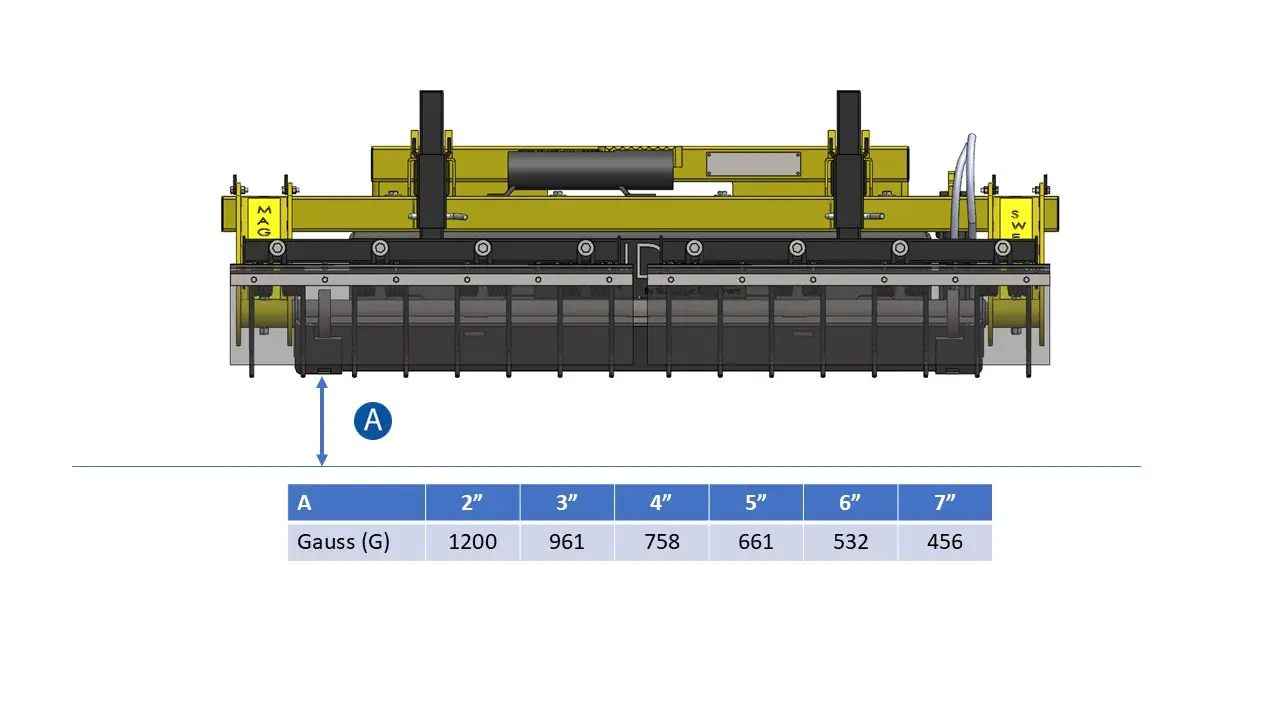
Sunda Guass Measurements
A: A = Distance from Magnet (Sweeping Height)
Note: Gauss (G) shown is the peak gauss measured in the center of the magnet at each distance.
Sorry, no reviews match your current selections
$764.81
Get a preview of the Sunda Magnetic Sweeper for Skid Steers / Track Loaders.
The Sunda’s 12” x 11” x 48” C8 ceramic magnet uses a double pole assembly to create a more concentrated magnetic field in the recommended operating range. Since the Sunda was built for retrieving steel ball mill abrasive balls it needs that much magnetic power to be able to effectively pick the balls up consistently. This video shows how many 20mm balls the Sunda can hang on to without dropping any.
To test the holding power of this magnetic sweeper, just to give you an idea of how many of these balls this Sunda will hold in terms of pounds, what we’re going to do here is, we’ve got this nice pile of balls that’s all concentrated together, and what we’re going to do is pick them all up. We pick up as many as we can while still holding it on the magnet, take it over to that clean area over there, and at that point, I’m going to go over with a Powerstick Pro Elite and a bucket, give you a time lapse of that, and see how many pounds of these we can actually hold.
So, that looks like about as many as we can pick up. A couple are dropping off. So, this is a 12×12 magnet, similar to what’s in the Mammoth, but this one’s actually a little stronger, just thanks to some tweaks we did. And, yeah, we’re going to go over to somewhere clean over there, where there’s no other balls, try to drop them in as neat of a pile as possible, and then we will try to get a time lapse going and see, well, number one, how many times we have to bend over and pick them up, and number two, how many pounds we can actually get. So, we’ve got a little scale that goes up to 400 lbs, and we’ll see how many pounds we actually get.
So, let me take you over without cutting here so you know we’re not faking the funk. Jeez, dodging drones. So there’s our pile. That’s how many balls the Sunda will hold without losing them. So we’ll get a bucket and a Powerstick and be right back.
Okay, so we cleaned up all the balls that the Sunda could pick up, and we’ve got two—what are these—5-gallon buckets. This one’s about 2/3 full, the other one’s about 3/4, and we’re going to weigh them and see what we’ve got.
115, so 115 in this pail. So this one should be about 130, 132. So what’s 115 plus 132? 247 lbs. I think I guessed 300 on the way here, so that’s pretty close. So there you go, 247 lbs. That’s how much weight in these 20 mil balls that the Sunda will hold without dropping. Your results will vary based on what kind of balls you’re using, right? Smaller ones hold more. Yep, they’ll hold more small balls than large balls. I think it should, ’cause you can pack them tighter. So let’s put these back in the…
The Sunda Ball Mill Abrasive Clean Up Magnet holds on tight to any debris that it collects, this helps when the bottom of the magnet hits the ground to retain debris using the wrap around function that allows debris to snap to the back of the magnet rather than getting wiped off. This video shows how hard the Sunda holds onto a 3” diameter steel ball.
Okay, so this is just a little behind the scenes of cleaning up after a shot. We’re picking up these sample balls. Don’t want to pull this off on John to get his camera, because I just want to see—there’s your—that’s how hard it holds on to them. She’s on there. You’re less likely to lose them when you’re picking them up. It’s got to be 50 lbs of force, easily. Maybe 60, I don’t know.
The Sunda Ball Mill Abrasive Pickup Magnetic Sweeper utilizes the skid steer’s auxiliary hydraulics to power a ram that presses a 12-gauge stainless steel debris pan away from the magnet so the collected debris is removed from the magnetic field so it will be dropped on the ground or directly into a bin / dumpster.
So, I’ve shown the clean-off system in the debris pan already on this Sunda magnet, but here’s going to be a little closer view of it. We just got a couple balls on the ground, so it’s not going to be so violent when it cleans off, but it’s picking them up. We got the magnet set at—it’s got to be 7 or 8 inches off the ground, which is really not what we recommend to do.
And it’s still picking up these 20-mil balls, so that’s the amount of pickup performance you’re going to get with this magnetic sweeper. This thing is 7 or 8 inches off the ground easily—maybe 6, I can’t tell from here—but it’s pretty high off the ground, and look at the collection it picks up from that. And there’s your clean-off. That’s just all that is: big hydraulic ram, you can see there, pushing against a giant lever, and that swings your pan down, cleans everything off for you.
So, this is run off auxiliary hydraulics. With anything that’s hydraulic, you get a little bit more—well, rather than our stuff that’s purely mechanical, there is the consideration of having to inspect your hydraulic hoses and make sure your hydraulics actually work. So, there’s your pile you can get with the magnet 7 inches off the ground. They kind of all stick to each other at that point. And then there’s the clean-off. You can see when the balls are on there, it cleans off a ton faster than if there’s nothing on it, because that ram is actually building up pressure and releasing it, kind of like a shot. So, it does drop them in a pretty neat pile, but they do kind of fly out.
So, you see it again here. He’s going to just click hydraulics, and there you go. So, that’s the clean-off of the Sunda magnetic sweeper. It’s just run off your auxiliary hydraulics, hooked up right there. There’s male and female standard adapter plugs, and that allows you to just drop everything in a nice controlled pile. You don’t have to worry about things flying all over the place too much, and it’s a good demonstration of magnetic power here—about all the balls that thing’s actually going to hold before it starts running out of juice. So, it will vary between the size of balls. I believe smaller balls, you’ll be able to fit more on there just because you can pack them tighter, but these 20-mil ones—we’re going to wait in a little bit and see how much, how many pounds of 20-mil balls it’ll actually hold
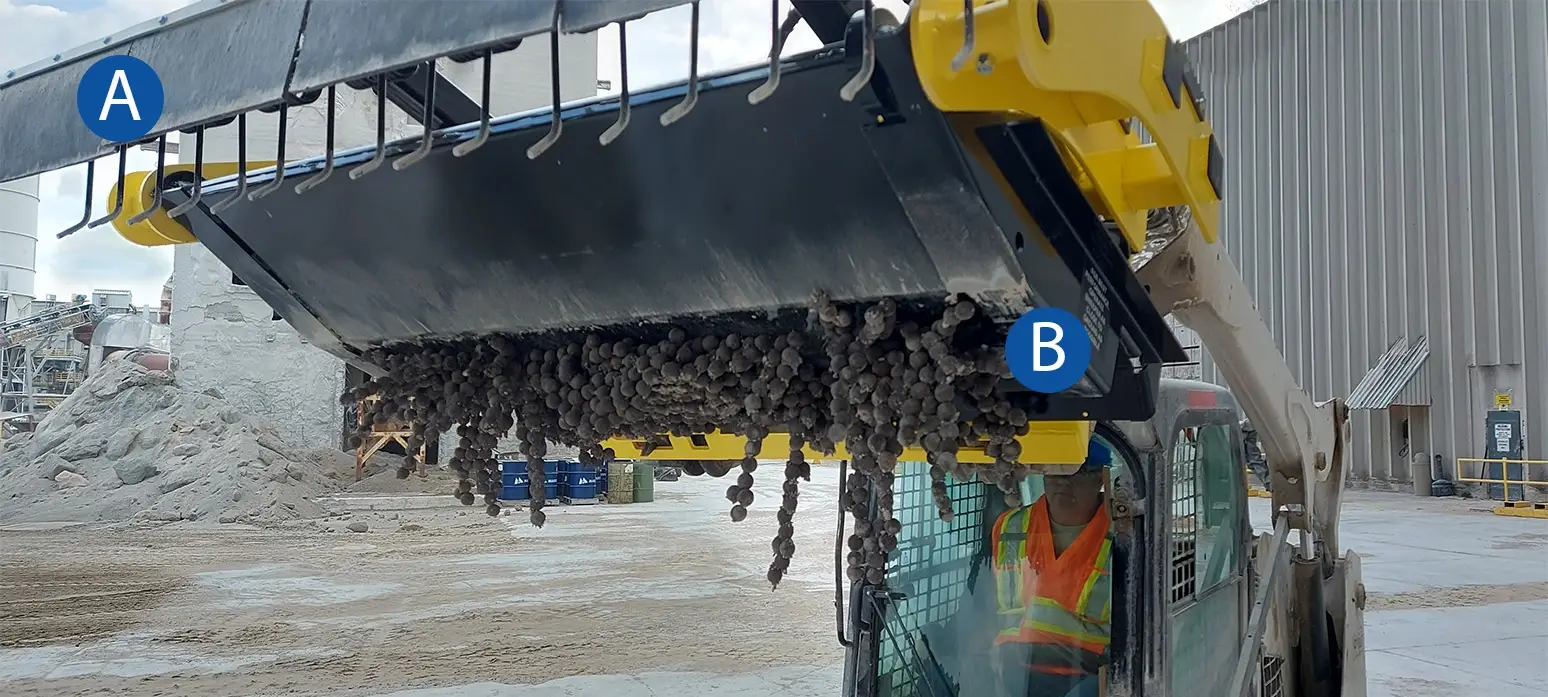
A: 12-gauge stainless steel debris pan protects magnet housing and separates debris from magnetic field
B: Hydraulic ram presses debris pan away from magnet
C: Attaches using Universal Sked Steer Adaptor Plate
The Sunda Ball Mill Clean Up Magnetic sweeper was developed specifically for cleaning up steel balls used in ball mills, the amount of magnetic power available with the Sunda is more than what is required to pick up normal metal debris (nails, bolts, wire, screws, tools). Steel balls are the most difficult debris type to pick up since all the weight is in the center and there isn’t much ferrous (magnetic) material available for the magnet to grab onto at the top of the ball nearest the magnet, so that is why the 12” x 11” x 48” magnet is needed. These videos show the Sunda working at a cement plant which just got a shipment of 20mm steel balls delivered for the ball mill on site and the Sunda picking up steel balls of various sizes.
Processing plants of all kinds that are, you know, processing rock into either an ore or a cement in this case, or just combining materials to make cement—what do they call clinkers—they oftentimes use ball mills to crush up the rock. That works very well; it’s been working for over 100 years. But what happens with this is you have to manage picking up these balls, which works fine when you’re scooping out of a bucket or just unloading from a trailer. But in this case, it’s pretty exaggerated how many are on the ground here. When you’re trying to pick up the last little bit off the concrete, that’s where a magnet comes in.
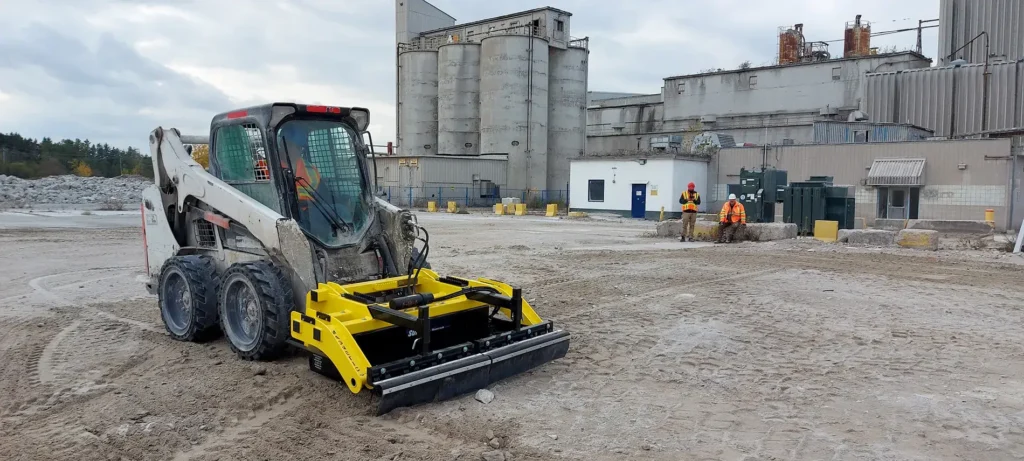
So these mills have to clean out—or these plants have to clean out—their ball mills once a year, generally, and when that happens, a lot of these balls get spilled on the ground. So that’s the case where this Sunda magnetic sweeper is going to come in handy. This thing is a 12×12-in. magnetic sweeper that’s 49 in. wide. The reason it’s a 49-in. sweeping width is so it can work on most skid steers, and in this case, we have it on a Bobcat S570. That brings the product weight up to about 1,900-and-some-odd pounds—I think it’s 1,920, which means even when you drop it like that, it’s still pretty stable and it’s not going to tip the Bobcat.
Alright, the Sunda magnetic sweeper. So this thing is built for picking up steel balls on processing sites. This place is a cement production facility, so they use these balls to go inside their ball mill to crush up rock and lime and whatever else the ingredients are for concrete and make that into what’s called clinkers. So the Sunda is specifically built to clean up these kinds of balls, and we have an exaggerated amount on the ground right now. But if you look under that skid steer, it’s clean so far, so that’s almost acting like a magnetic bucket, just to push the pile. It didn’t keep them all on the bottom of the magnet, but it brought them all with it.
There’s your cleanup. It’s pretty violent.
So the Sunda magnet, like I said, was built to clean up these balls that were used at ball mills for processing all kinds of ores and rocks and that sort of thing. This only usually becomes a problem at these places once a year when they do the cleanout, but this place just got a new shipment of balls in and they let us run the Sunda around and see what the performance is like at picking up these balls. So these are fresh 20 mm balls, and yeah, we have a giant pile there—a bucket full, I believe—and it pushes them all kind of like a bucket. So even if you’re not able to get close to the ground, not able to, you know, run your bucket across the ground, this is going to work fine for you just to move them and get them out of the way.
Okay, so there is the Sunda, and it’s, like I said, a 12×12 magnet assembly, kind of like the Mammoth, but it’s a little bit different design, and instead of moving the magnet up like we do in the Mammoth, this one has a pan that moves down. So that’s a big thick stainless steel pan on the bottom of there, which allows magnetism to go through but captures the balls before they actually touch the magnet for easy clean off. So this thing is a 1,900-lb unit with a giant hydraulic ram on one side that just runs off your auxiliary ports on the skid steer. All that one hydraulic ram does is push against a giant lever that’s on the pans—or on either side of the pan there’s a giant lever—but it just pushes on the one side with the ram, and that causes all your debris that’s stuck to the debris pan to be separated from the magnetic field so you can drop it on the ground without having to overcomplicate anything.
So I think this magnet has a 15-in. maximum pickup height, using a nail. If you’re not going to use this thing regularly—like I said, you only really use these once a year on a ball milling site unless you have a spill or something like that—but even if you’re not using it for picking up the steel balls, it’s going to be excellent for picking up any kind of debris you may have in your yard after construction or whatever else, because it’ll pick up a nail from 15 in. So you can get any kind of debris at any speed with a skid steer and run it high enough off the ground that you don’t have to worry about hitting anything.
So there’s a shot of the clean off again. He’s got that giant collection of balls on the bottom, and then all he’s got to do is just hit the auxiliary switch and it pops that pan open like a gunshot, cleans them all off. So there’s your pile of how much you can collect with the Sunda in one pass. Yeah, even if you’re not using it for the balls, it’s going to be a great just general debris cleaning unit just because of the massive size of the magnet. Like I said, this is only a 49-in. sweeping width—or 48. The reason we did that is because it’s a 12×12 magnet, and if we were to make it as wide as, like, our Meerkat or something else like that—68 in. wide—then it would be too heavy for most skid steers. So we built this to work on a lot of skid steers. It’s not going to work on your smallest options, but this is a fairly common one, the S570 from Bobcat, and it seems to have no problem despite the 1,900-lb weight of the sweeper.
So if you look at the front of the magnet there, you’ll see there’s a big rubber guard with some little teeth sticking out. What that is, is our debris digging rake system. What that’s going to do for you is if anything is stuck in the ground—underground, like has been packed in or something like that—then you can deploy those and kick them up out of the ground. You see this thing makes light work of picking up these balls. I mean, if you had to pick these up with a bucket, you’d be here with a broom and a shovel. You know, that’s not a fun job. So this thing, you just run them over with the skid steer—probably got heat and air conditioning in that thing if you’re lucky—and that makes the unpleasant job of getting that last 10% of these balls off the ground a pretty easy one.
So as you can see, another shot of the pan there, it swings all the way up and that’s what separates your debris from the magnet, and that makes it really easy—just drop off in some kind of a ball bunker, or they’ve just got them pushed up against the wall here for easy pickup of the bucket.
So see, it picks up that small amount, no problem, off the ground. We were speaking to the operator here and he just said exactly what I said. He said they use the bucket for 90% of moving these things because they get dumped in a pile, like I showed you in the corner. But the bucket can only get, he says, 90%, and then after that it’s a shovel and broom job. I’d rather be sitting in a skid steer than operating a shovel, so that’s where the Sunda comes in, because this ground isn’t perfectly smooth. You can’t just run a blade off like it’s a grader, so if you got something that’ll pull stuff up and out of the ground, up and out of cracks, and whatever is—you know, it’s uneven ground surface to working site, it’s not a mall—so if you’ve got something that can pick up these balls out of that, then you know it’s going to make a lot easier, make a couple guys’ jobs a lot easier. Rather than three dudes sweeping up 1,000 lbs of steel and putting it in a bucket, you’ve got one guy who just dumps it and picks it up off the ground and dumps it somewhere it can get scooped up easily.
Yeah, the Sunda is not your general-use skid steer magnet. I mean, if you want the best power available on the market until we make something bigger, then this is your option. This is the big one. Now, this isn’t what I’m going to recommend for your average construction guys, just in case, unless you need to pick up cannonballs out of some dirt, but it’s meant for a specific task. It’s meant to pick up these balls—it’s built for this—but as a side effect, it’s going to be a great magnetic sweeper just for general use. If these guys don’t need it every day like they say they don’t—they say they only use it once, twice a year—I mean, it’s still a great sweeper just to pick up nails or whatever else is out here. They’d probably be shocked by what’s in the ground just from—you know, there’s construction going on all the time.
As I mentioned earlier in the videos here, this thing has our debris digging rakes on the front of it. This comes standard with the Sunda. So what these are for is exactly what we’re doing with it. If you’ve got some softer ground you want just smoothed out, take any breaking bumps or rain ridges or anything like that out of it, any ruts, you got these. They work doubly as just kind of like spring teeth to groom—well, they are spring teeth—so they work to groom the ground, and what it also does for you is it picks up or it kicks up, rather, any metal debris that might be stuck underneath. Now, these guys said they don’t really have a problem with debris; they don’t get flat tires, but that’s mostly because everything out here has either giant solid tires or it’s that loader in the background, so it’s not going to get a flat from just nails. But this is just part of the function of this magnet. It’s another feature you get: the spring teeth on the front of it. You can ram those things right in the ground, and you’ve got the stone guards in the front to protect anything that’s nearby from getting hit by a rock that gets flung up. I believe these are 3/8-in. spring teeth on here, so lots of power to push the ground. You can really dig them in and they leave a nice smooth surface like that. This place is already pretty smooth; you can see you hit in the ground there a couple times.
So while he’s doing this, there’s another feature of the magnet that’s kind of getting used. As he’s sweeping here, he can’t see exactly what’s underneath the magnet, so when he hits a high spot—like right going up that hill—that magnet’s going to bottom out. You can see those smooth patches there in the frame; that’s where the magnet’s bottoming out. Now, that’s not a problem with the Sunda. You’re not going to lose any of the debris you collected, like the nails you got aren’t going to fly off when you hit the back, because the way the debris pan is designed, it touches the back of the magnet housing. So that giant 12×12 magnet block that’s in there is actually touching the back of the stainless steel debris pan. So if anything does hit the ground and get wiped to the back, it’ll just stick on the back of the debris pan. This is what’s called our wraparound function.
As I was talking about before with the wraparound function, you’ll see he’s only really getting just a bit of slag from the sand there, but let’s see if I’ve got some light—can’t tell if everything’s dusty. But anyways, all the slag that’s been collected after it gets knocked off the main pan from hitting the ground, like you did a couple times, it just sticks on the back of the debris pan, which is a wraparound function that’s on pretty much every magnet.

Out on the ground here, we have a selection of different size balls used in ball mills. We’ve got everything from about 3 inches to, looks like, only 10 mm. So, this is the Sunda magnetic sweeper picking those up from a skid steer with a sweeping height of about 5 to 6 inches.
There are the balls on the magnet, along with the clean-off, so you can see that flung them everywhere. If you look underneath the skid steer, just the one that’s rolling back is the one we missed, so we’ll have them run that again down this strip just so you can see from the front how many are getting missed, if any.
Again, this is about a 4-inch sweeping height. We’ll have them pick it up, and if you look under the skid steer, there’s none left behind. There’s your clean-off. So that’s all of our sample balls we got when we were designing this thing, and that’s everything from a 3-inch ball down to about a 10 mm ball with our Sunda magnetic sweeper.
So, this thing should be suitable to clean up any kind of ball mill abrasive that you might have, and you can see it’s pretty easy—you just drive over.
A: 3/8” steel spring teeth with 3 settings agitate surfaces to pull more debris
B: Powerful 12” x 11” C8 ceramic magnet holds 247 lbs of 20mm steel balls
The 18.5” Inside top of Universal Adaptor Plate to bottom of magnet design and 0-degree lead in allows for easy magnet positioning – you can couple into it and if you set the lift arms of the skid steer on the lower stops it will provide a 2.5”- 3.5” sweeping height, so you can’t easily ram it into the ground. Check out this video to see POV operation of the Sunda on a Bobcat S570.
The Sunda Ball Mill Abrasive Clean Up Magnet weighs 1922lbs, to safely use this magnetic sweeper on a skid steer / track loader, the machine will need to be able to comfortably lift that much weight without becoming unstable. The Sunda also requires auxiliary hydraulics for clean-off.
Metal debris can get stuck in the ground from getting run over by vehicles and heavy equipment. Over time the debris will get pushed back up from weather changes and can create another hazard. Using the Debris Digging Rakes that come standard on the Sunda Ball Mill Abrasive Pickup Magnet will help to loosen up the ground you are operating on and kicks metal up and out of the ground so it can be collected by the magnet. This allows for a more thorough cleaning while also grooming the surface you are operating on.
Okay, here’s a video of how to deploy the debris digging rakes that come standard on Sunda. So, it’s just a big metal squared piece of steel inside of a slightly larger piece of steel that slides up and down. You just got a standard tractor pin with a cotter pin on it. You drop it down—looks like there are three height settings—and then you pull the pin back out when you’re done with it. Push them back up and put your cotter pin back in.
So, even with these deployed, you can still—if you don’t want to use them without having to get out and adjust the height—you just roll the magnet all the way back, and so they’re off the ground even when they’re at their full depth. You just roll the magnet all the way back so they’re off the ground, and because the magnet’s touching the back of the debris pan, it’ll still have the same pickup performance or very similar.
So, if you even have the rakes—like I said, if you got the rakes deployed and you don’t really want to use them, but you don’t want to get out and adjust them—you just roll your magnet all the way back, so you’re like you’re rolling back a bucket so the back of the housing is near the ground. That’ll have the same pickup performance as if you just didn’t have the rakes down, you were running flat.
As I mentioned earlier in the videos here, this thing has our debris digging rakes on the front of it. This comes standard with the Sunda. So, what these are for is exactly what we’re doing with it. If you got some softer ground you want just smoothed out—take any breaking bumps or rain ridges or anything like that out of it, any ruts—you got these. They work doubly as just kind of like spring teeth to groom—well, they are spring teeth—so they work to groom the ground. And what it also does for you is it picks up any—or it kicks up, rather—any metal debris that might be stuck underneath.
Now, these guys said they don’t really have a problem with debris. They don’t get flat tires, but that’s mostly because everything out here has either giant solid tires or it’s that loader in the background. So, you know, it’s not going to get a flat from just nails. But this is just part of the function of this magnet—it’s another feature. You get the spring teeth on the front of it, you can ram those things right in the ground, and you got the stone guards in the front to protect anything that’s nearby from getting hit by a rock that gets flung up. I believe these are 3/8″ spring teeth on here, so lots of power to push the ground. You can really dig them in and they leave a nice smooth surface like that.
So, this place is already pretty smooth. See, he’s hitting the ground there a couple times, but you know there’s some lumps and bumps—might as well smooth it out for them while over here.
So, while he’s doing this, there’s another feature of the magnet that’s kind of getting used. So as he’s sweeping here, he’s not really—he can’t see exactly what’s underneath the magnet. So when he hits a high spot, like right going up that hill, that magnet’s going to bottom out. You can see those smooth patches there in the frame; that’s where the magnet’s bottoming out. Now, that’s not a problem with the Sunda. You’re not going to lose any of the debris you collected—like, the nails you got aren’t going to fly off when you hit the back—because the way the debris pan is designed, it touches the back of the magnet housing. So that giant 12×2 magnet block that’s in there is actually touching the back of the stainless steel debris pan. So if anything does hit the ground and gets wiped to the back, it’ll just stick on the back of the debris pan. This is what’s called our wraparound function.
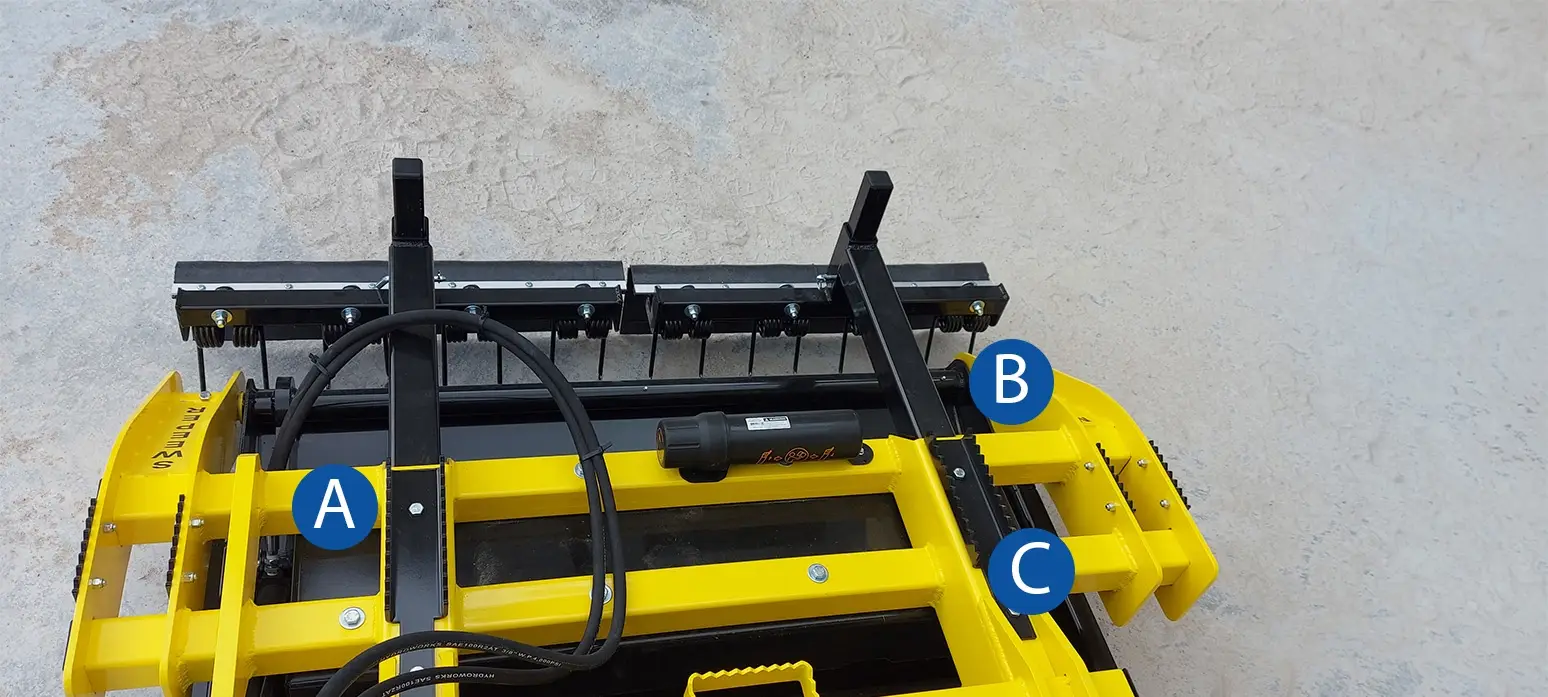
A: Hydraulic powered debris clean-off
B: 1.9” diameter steel debris tray pivot points with grease fittings
C: Steel teeth to prevent while entering machine cab
The magnet assembly in the Sunda Ball Mill Abrasive Clean Up Magnet was designed to retrieve steel balls, which is the most difficult debris type to pick up. As a result, the Sunda is exceptional at retrieving all debris types. It will pick up a 2.5” inch nail from 16” inches off the floor. This gives more than enough power to sweep at the recommended 2” – 5” sweeping height while at speed.
Maximum pickup height video for the new Sunda magnetic sweeper. We have it set at 16 inches off the ground here, and we’ve got our 2 and 1/2 inch 8-penny nail on the strip of cardboard. It should pick it right up.
The Sunda has massive magnetic power which is more than enough for most debris cleanup efforts. Running the Sunda on a skid steer to collect nails, bolts, rebar, screws and wires allows the operator to run the machine at whatever speeds they are comfortable with while still collecting all the debris on the ground. The Sunda works fast to clear large spaces.
Okay, here’s the Sunda performing normal magnetic sweeper duties. So, this is a section of the lot here at the cement plant that’s been known to have some bolts in it. I believe they took down a building or something here; that’s why there’s all this rubble and dirt in the background. So, what we’re doing here is we’re running the rakes down on the second level. What that’s going to do is kick up anything—there’s, I think, some rebar and just old steel in here—so that’ll kick up anything that’s just under the surface. Then that giant Sunda magnet is going to pull it out, which is an 11 by 12. Again, it’ll pick up a nail from 15 inches, so it should be able to pull some metal from the dirt here. So, we’re going to do a couple quick passes here, maybe get a couple pictures, shoot a quick video here like this, and I think that’s it.
This thing worked great today just for picking up the bolts that we’ve found so far, and it’s also done a great job just, you know, being pretty easy to operate. I got hopped in that Bobcat and in a couple minutes I figured out how to run it properly. After that, it’s just running around and trying to pick up some metal. So we’ll let it get a couple passes here, and then we’ll get in tight and see what kind of debris we got.
Okay, you see Sunda still sweeping here. Looks like we got some debris on the back. You won’t be able to see it from this distance, but I can see that there is some pretty good-size debris stuck to the back of this magnet. So that’s the wraparound function in action, because obviously as he’s driving, this terrain’s changing and he’s not constantly moving the magnet up and down. So, the wraparound function lets all the debris stay retained on the magnet by letting it slide and snap back around to the back of the housing, because the back of that debris pan is touching the back of the magnet housing. The magnet power is still on the back, which keeps debris on, even through the rough stuff. You might be able to see in there, maybe not, ’cause it’s kind of tight, but anyways, it keeps the debris on there even in the rough stuff. So you don’t have to worry about constantly feathering your controls.
And that 12-gauge pan on there can take a hit. I was just driving the thing and bashed it into the ground a couple times, and it’s fine. There are no dents; there’s a couple scratches, but it’ll be okay. So yeah, this thing’s pretty worry-free. It’s such a powerful magnet, you can actually just set it up way higher than you think you need to, and it’ll work fine because it’s so strong. It’ll operate in a sweeping range that you don’t generally have to worry about hitting the ground unless you’re really in the rough stuff. Like, this isn’t too bad—this is just sand—but any real rocky, hard terrain, you can set it up there. You don’t have to worry about bashing it into the ground, and it’ll still be picking up plenty of debris just thanks to the massive pickup height from that 12 x 11 magnet.
You see everything else out there that’s actually big enough to give a load or a flat. So, here’s a view of the debris pan after we’ve bashed the hell out of it. I know I’ve bashed it into the ground many times. You can see right there where I’m probably hitting it. There are skid plates on either side, just extra thick areas where you’re meant to bash it into the ground—well, not meant to, but it’ll slide over everything. And yeah, there’s one quick run through that dirt kind of parking lot area behind us, and the Sunda gets a nice job done and cleans up all this metal for them.
And I was using the debris digging rakes also.
The Sunda Ball Mill Abrasive Clean Up Magnet has a ton of features that make collecting metal using a skid steer / track loader an easy job. This video goes over the features of the Sunda and how they help the Sunda work more effectively.
This is Blue Streak Equipment’s new Sunda magnetic sweeper. This magnet was built for picking up balls. As you can see behind me, there’s a big pile of balls. So, this is built for picking up steel balls that are used in ball milling and ore processing, rock crushing activities. We’re at a cement plant today that’s pretty close to us that has a ball mill. They use these 20 mm balls to crush up rock to make cement, or whatever—yeah, cement.
This thing was designed for cleaning up those balls after we got a request from a similar outfit in Alberta. These balls get all over the place during their clean-off, which happens about once a year. Some places do it twice a year. The other people we talked to said twice a year, but these guys do it once a year. At that point, the mills get dumped out, and there’s a big piece of shielding inside that gets torn up and has to be replaced, and the balls get replaced and all the bad ones are thrown out. At that point, they get new balls, and the old balls they’re going to reuse get stored in what’s called a ball bunker a lot of the time.
The reason that happens is because it’s easier to pick up with a bucket since it’s a round cylinder. If you try picking it up with a bucket, it rolls unless you’ve got a backstop, which we just experienced trying to pick it up with a shovel. So, the whole idea with the Sunda is it’s more maneuverable than our Mammoth. The Mammoth was a trailer, so you have to be able to back up a trailer—which is tough for some people—and this is a tighter, more compact platform. There are fewer moving parts and less complexity with electronics. All this is is an 11×2 magnet assembly, very similar to the Mammoth—actually, a little bit stronger. It’ll pick up a 2-1/2 in. nail from 15 in., and when it’s time to clean it off, it actually uses the auxiliary hydraulics from your skid steer to activate a hydraulic ram that’s on one side, which pushes a 12-gauge stainless steel pan down and away from the magnet.
So, say your magnet’s here, pan’s here—it flips down like a lot of our magnets. It just hydraulically flips away, and then all the debris that’s caught in the pan will get pushed out of the magnetic field, which obviously cleans it all off. This pan is a 12-gauge stainless steel pan. There are two big levers—one on either side—that brace for rotating force. So, it’s got to be an inch-thick piece of steel that kind of looks like a dog bone that runs down either side. When you push on the one side (there’s only one ram), it allows it to open without flexing too much. You don’t want that side-to-side flexion. That is the clean-off system.
Everything else going on with this, like I said, it’s an 11×2 magnet, it’s a 49-in. sweeping width. The reason we went with 49 in. rather than our standard—I think we usually do about 67, 68, for skid steer magnets, up to 70 (well, we’ve got bigger ones)—but anyway, we normally do a little bit wider than the skid steer is. So, the reason for the 49-in. sweeping width is so most skid steers—not most, but a lot of skid steers—can use this thing.
When I was looking up, before I started filming this, a couple days ago, what kind of skid steers can lift a 2,000-lb thing, I came up with the Bobcat S590. But this is an S570 behind me, and it’s fine. It doesn’t tip; it works fine. So, as long as you’re around the 2,000-lb tip point, this should work. The whole sweeper assembly itself—magnet, rakes, everything on it, with hydraulic fluid in it—even weighs 1,922 pounds. As long as your skid steer is able to lift and move that around without tipping or being crazy, you’ll be okay.
With this magnet also comes our debris digging rake attachment. These are 38 spring teeth, like a lot of our other debris digging rakes. They’re adjustable—three positions up and down. All you have to do is pull a cotter pin, then tractor pin, slide them up and down wherever you want them, and those are used to kick debris out of the ground, as well as groom the surface you’re running on. We used it on a little bit of sand out here, which was fine, but these guys run a tight ship, so there was no debris out there, but it made it nice and smooth and it took out some ruts.
Everything else on this magnet is real heavy-duty steel. Everything’s powder coated; this yellow is a nice powder coating. It’s not going to chip very easily. Nice powder-coated black frame. We just tested the holding force of this thing with these 20 mm steel balls, and it held 247 lbs of steel balls lifted in the air while driving without dropping any. We swept them all up with this shovel and the Power Stick Pro Elite, put them in buckets, and weighed them—got to 247 lbs. That’s pretty good for a magnet that’s 49 in. wide.
This thing is light enough to use on a lot of skid steers. It’s maneuverable; you can run it anywhere you want. You don’t have to learn how to back up a trailer, you don’t have to worry about charging a battery like you do with the Mammoth; you just plug it into your hydraulics. As long as your lines aren’t shredded, as long as your hydraulics work on your skid steer, this thing’s going to operate. Everything’s really heavy duty on this thing. This was built to be one of the strongest skid steer magnets we’ve got, both in terms of bashing it into the ground and magnet performance.
On the back of it is just your standard universal skid steer plate. It’s just a universal adapter plate like you’ve got on every modern skid steer. It’s 18 – 1/2 in. from the top to the bottom, and what that gives you is a 3 to 4 in. sweeping height when you’re hooked up to the skid steer and you set your lift arms at the lowest point. You just hook into the thing, run your safeties, put your hydraulic hose on, and then tip it all the way back and drop it down and you’ll be at the recommended sweeping height.
We actually had the thing set at about 7 in. off the ground just because they were trying to film something, and it was still picking up a ton of these steel balls—probably at least 200 lbs. Considering we did 250, it probably had about 200 on it. So that’s the performance you can get with this Sunda magnetic sweeper. All the parts are available online and, yeah, if you’ve got a ball milling operation and need to clean up some balls, that’s a good ball grabber if I’ve ever seen one.
Of course, the wraparound function, like most of our magnets, it’s got the stainless steel pan that touches the back of the magnet housing, so you can run into the ground and it will just snap debris to the back of the magnet, rather than let it fall off. It’s got these nice little things to walk on, big steel teeth for your boots to grab into, so it’s not slippery when you’re walking into the skid steer. It’s as heavy duty as you can get. This is the heaviest-duty skid steer magnet we’ve built. It’s for extreme applications.
The only reason you would really need this thing is for ball mill clean up, ball cleanup, that sort of thing. Balls are the hardest things to pick up out of any type of debris, just because the cross-sectional ferritic content is low. All the iron is in the middle and there’s barely any on top for the magnet to grab, so it’s the hardest thing to grab, which is why you need the biggest magnet housing to do it.
Now, with that being said, with that giant magnet housing and that pickup power, you get pickup power—so for every other debris type, you can run as fast as your skid steer will go, pretty much 8 in. off the ground if you want, and it’s still going to pick up nails, bolts, whatever you’re trying to get. That’s not what it’s intended for—it’s intended for these ball mills—but if you need a heavy-duty magnet and you want the best, you want the highest power, you want the highest speed through—you know, you want to pull cannonballs out of the dirt—this is your guy.
If you are on a construction site in the Caribbean and you’ve got some cannonballs left over from the 1600s that you need to pull out of the grass before you plant—well, before you plant grass, you need to pull out your cannonballs—this thing will do it. This is the magnet for you. If you need to pick up roof nails, I do have the Power Stick Pro Elite, but yeah, it’s as heavy duty as you can get, it’s built like a tank. We’ve got all the parts online; if you break anything—I don’t know why you would—but get it online.
- No Surprise Border / Tariff Fees After Checkout
- Fast Shipping
- All Items in Stock
Secure Checkout
Fast Shipping
Easy Returns