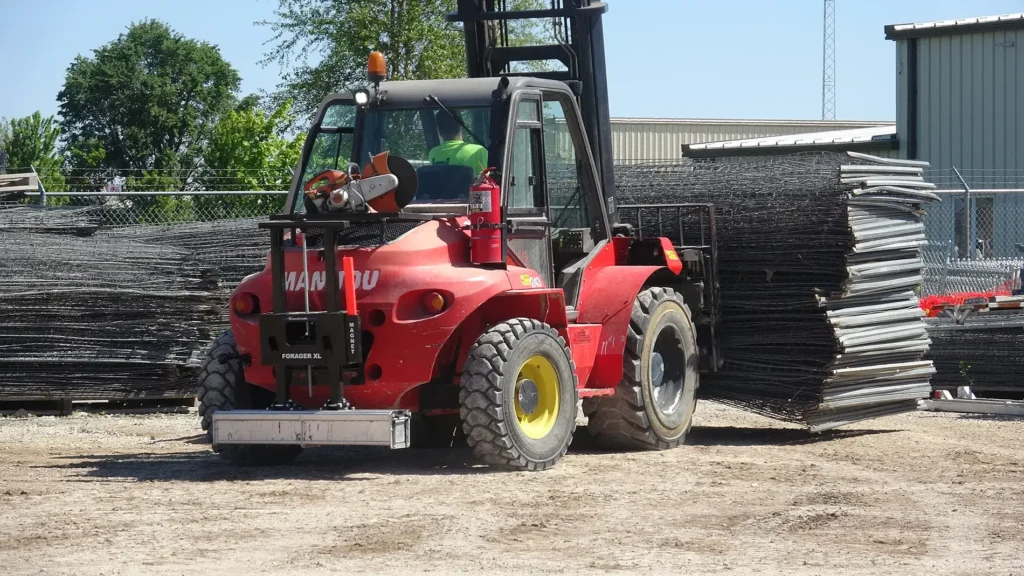
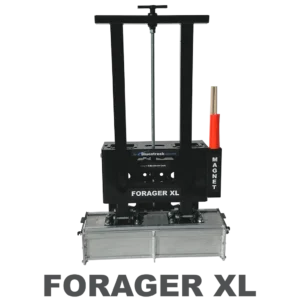
The Forager XL Heavy Duty Forklift Magnet is based on the original Forager but like the name suggests, it’s much larger. This rear mounted forklift magnet has a 7” x 7” permanently charged ceramic magnet housing can pick up a 2.5” nail from 12” off the ground. This pickup power allows operators of high-capacity rough terrain forklifts to mount the Forager XL Heavy Duty Forklift Magnet high enough to avoid ground strikes in rougher terrain while still confidently collecting all types of metal debris in the recommended sweeping height range of 4-6” inches while the forklift performs its normal tasks.
The Forager XL is built to work in tough conditions and endure ground strikes when working off-road. The aluminum magnet housing is protected by a sturdy aluminum quick clean off sleeve that slides smoothly on plastic wear strips. The Forager XL’s magnet assembly can pivot backwards, forward, both ways, or neither way if clearance between the magnet and counterweight isn’t available.
The pivoting motion protects the magnet assembly from impacts when moving by allowing the force of an impact to swing the magnet away. The entire Forager XL Heavy Duty Forklift Magnet Assembly can also move upwards freely in the steel outer housing to prevent damage from bottoming out.
The Forager XL mounts using the rear pin of a forklift and a vented steel mounting bracket that allows exhaust to flow through it to accommodate forklifts that exhaust through the rear pin port. This bracket is secured using a machined pin hook and threaded rod that goes through one of the many holes in the bracket, allowing for different height rear pins. The rest of the Forager XL mounting assembly drops onto this bracket and can be tilted in or out to account for the angle of the counterweight on a forklift, this allows the Forager XL to fit on almost any forklift.
$6,689.99 – $7,229.99Price range: $6,689.99 through $7,229.99
See Pricing For All Models Below
$6,689.99 USD
$6,909.99 USD
$7,229.99 USD
| Forager XL Series | Forager XL 31 | Forager XL 39 | Forager XL 47 |
|---|---|---|---|
| SKU | FXL31 | FXL39 | FXL47 |
| Maximum Lifting Height | 12” | 12” | 12” |
| Sweeper Weight | 436.5 lbs | 490.5 lbs | 544.5 lbs |
| Sweeper Width | 31” | 39” | 47” |
| Sweeping Height Adjustment | Yes, 4-6” recommended | Yes, 4-6” recommended | Yes, 4-6” recommended |
| Clean Off Method | Via aluminum quick clean off sleeve | Via aluminum quick clean off sleeve | Via aluminum quick clean off sleeve |
| Terrain Surface | All Terrain | All Terrain | All Terrain |
| Pricing Range | $6,689.99 USD | $6,909.99 USD | $7,229.99 USD |
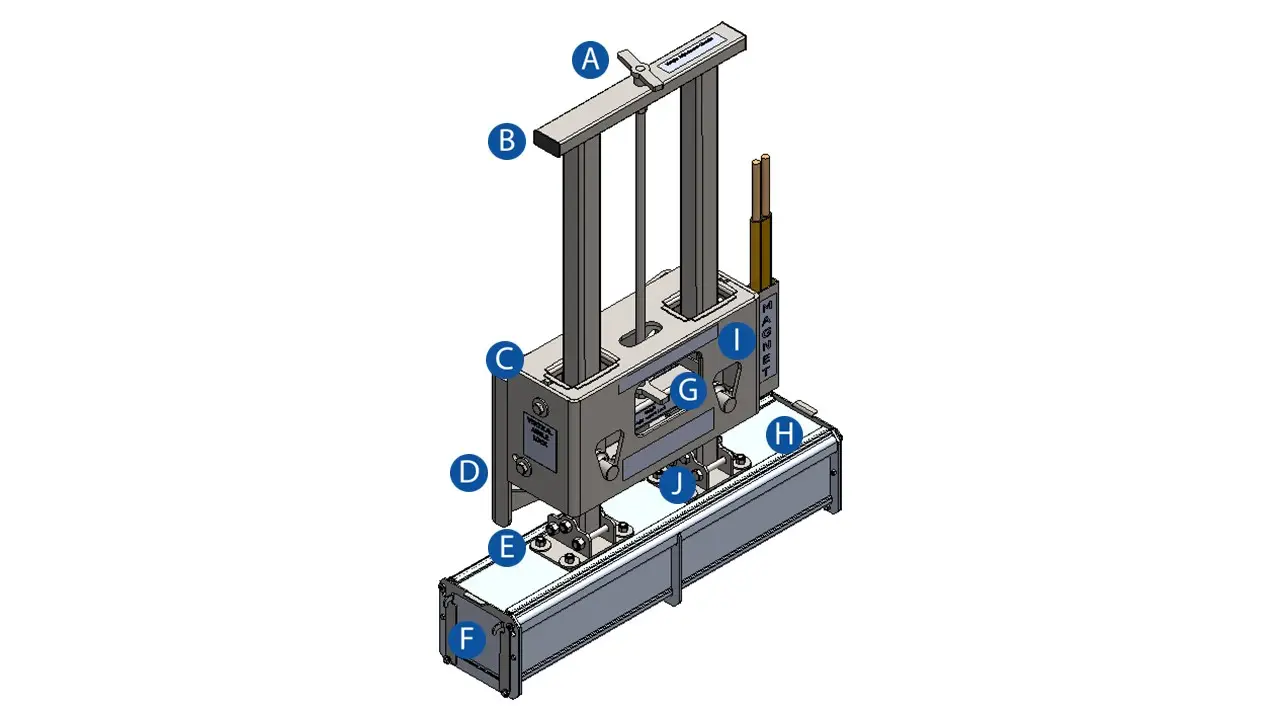
Forager XL Heavy Duty Construction
A: Steel sweeping height adjustment frame handle
B: Plastic end plugs
C: 0.375” (3/8”) thick steel outer housing
D: Angle lock
E: 0.25” (1/4”) thick steel pivot bracket
F: 0.75” (3/4”) thick 6061 aluminum end cap
G: Steel height adjustment lock
H: 6061 Aluminum Quick Clean Off Sleeve w/ plastic wear strips
I: Steel guiding frame
J: 7” x 7” x 0.25” (1/4”) thick wall 6061 aluminum magnet housing
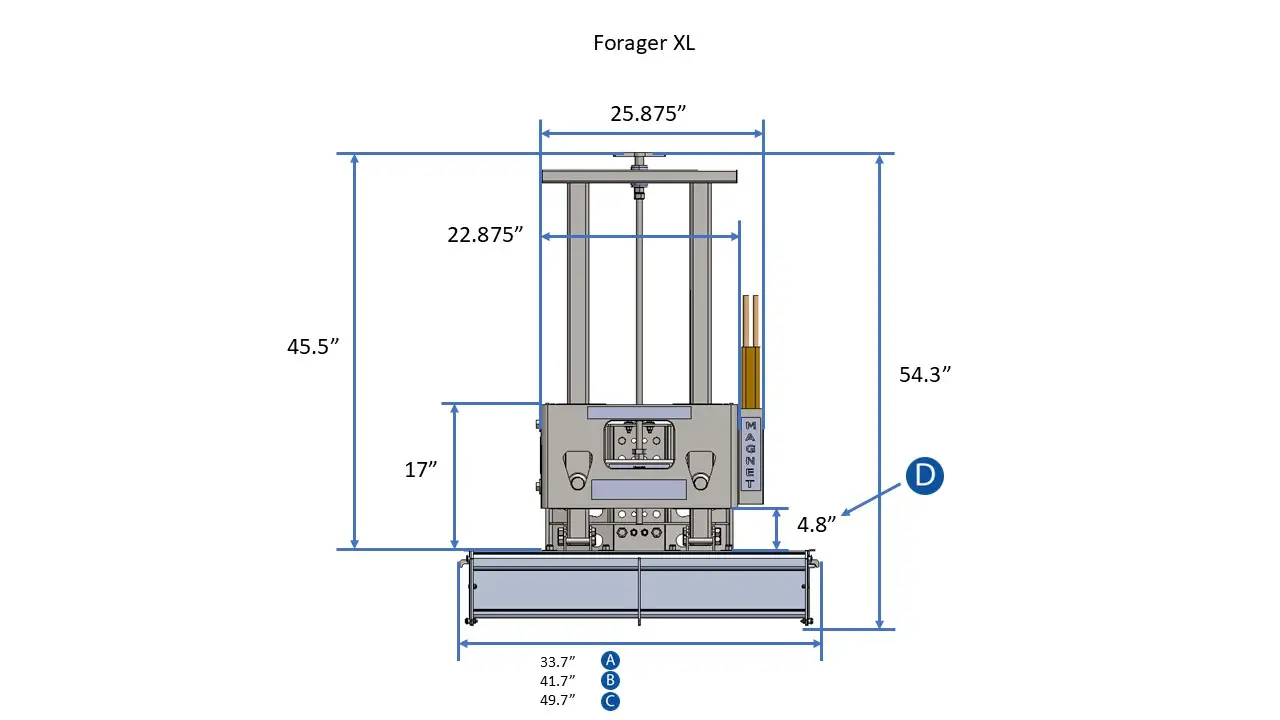
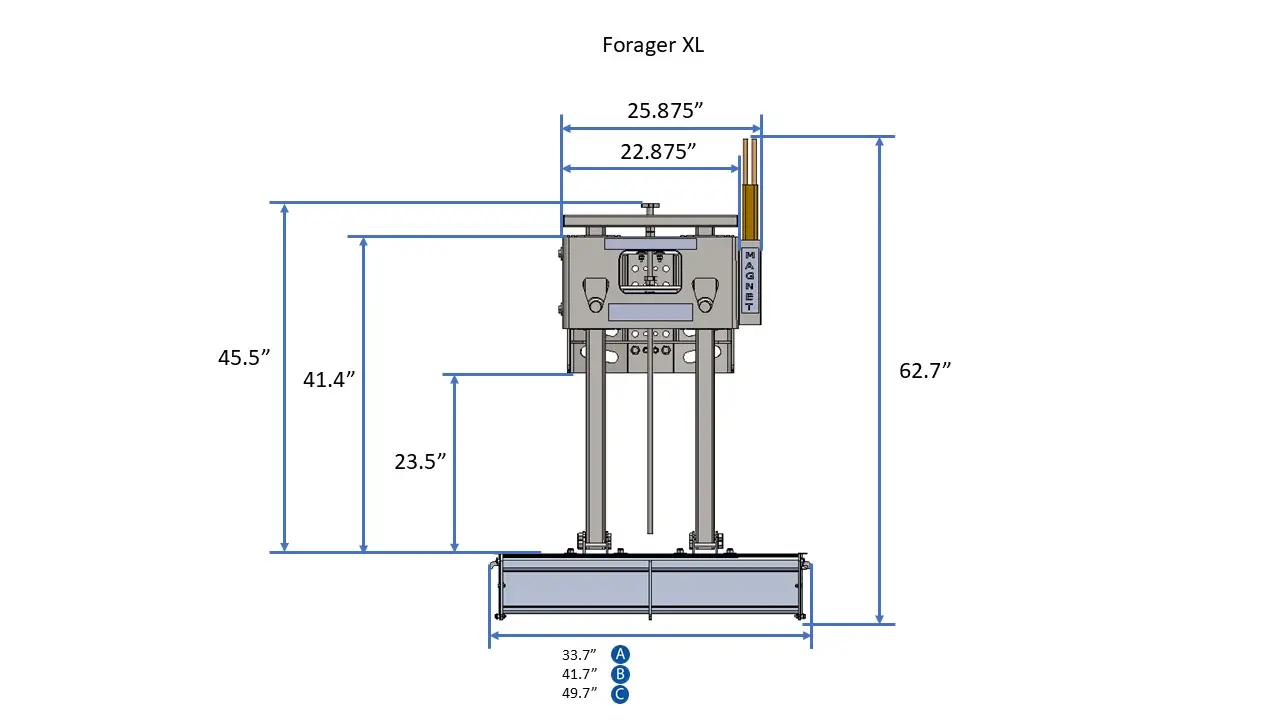
A: 33.7” Total Width (31” Model)
B: 41.7” Total Width (39” Model)
C: 49.7” Total Width (47” Model)
D: Minimum distance required for full pivot of magnet to 90 degrees
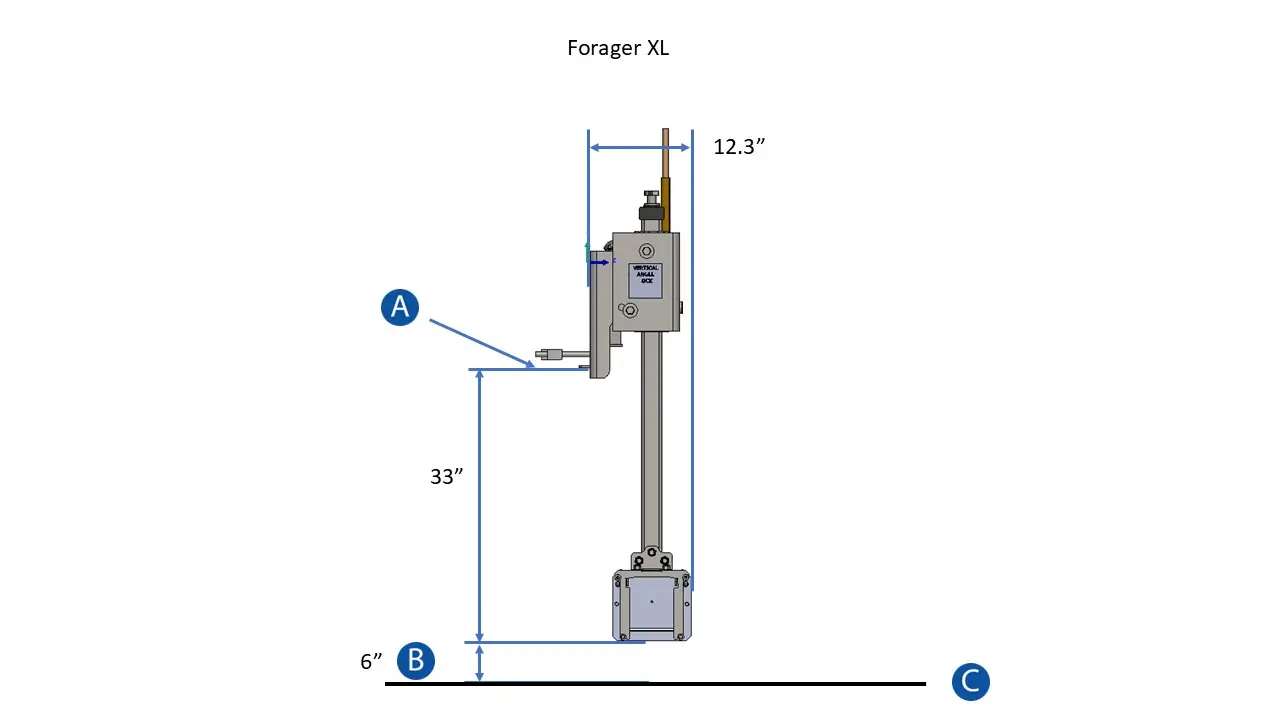
A: Bottom of pin slot
B: 6” recommended max sweeping height
C: Ground
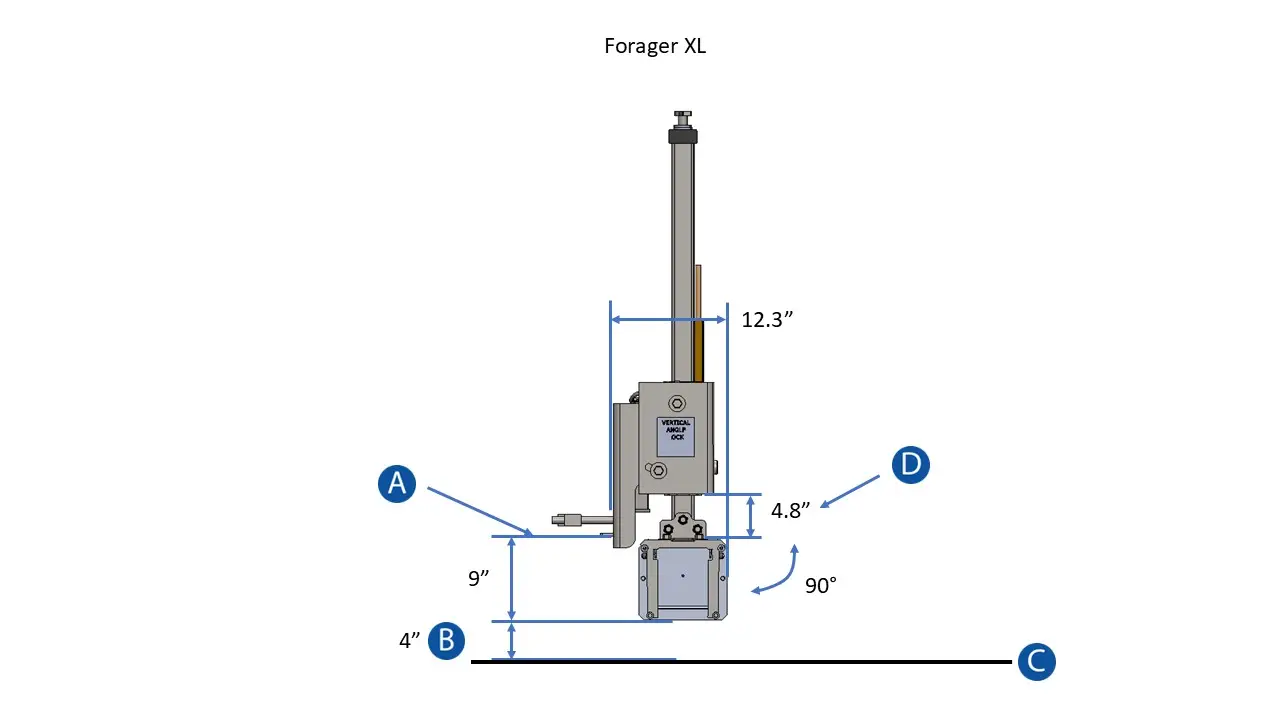
A: 33.7” Total Width (31” Model)
B: 41.7” Total Width (39” Model)
C: 49.7” Total Width (47” Model)
A: Bottom of pin slot
B: 4” recommended min. sweeping height
C: Ground
D: Minimum distance required for full pivot of magnet to 90 degrees
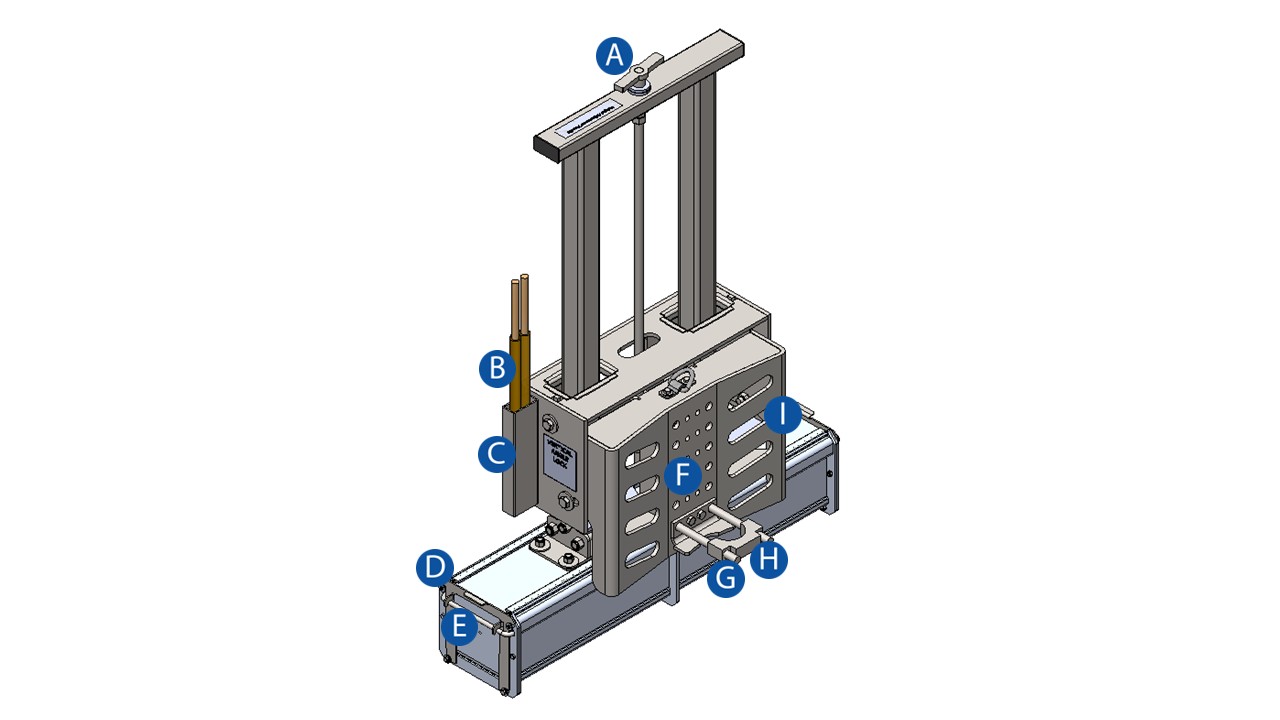
A: Steel height adjustment handle w/ 0.75” (3/4”) diameter threaded rod and UHMW washers for easier turning
B: Orange poly fabric debris catcher
C: Debris catcher holder
D: 10-gauge thick steel sleeve retainer
E: 0.4375” (7/16”) dia. stainless steel pull handle
F: 0.3125” (5/16”) thick steel bat wing stabilizer
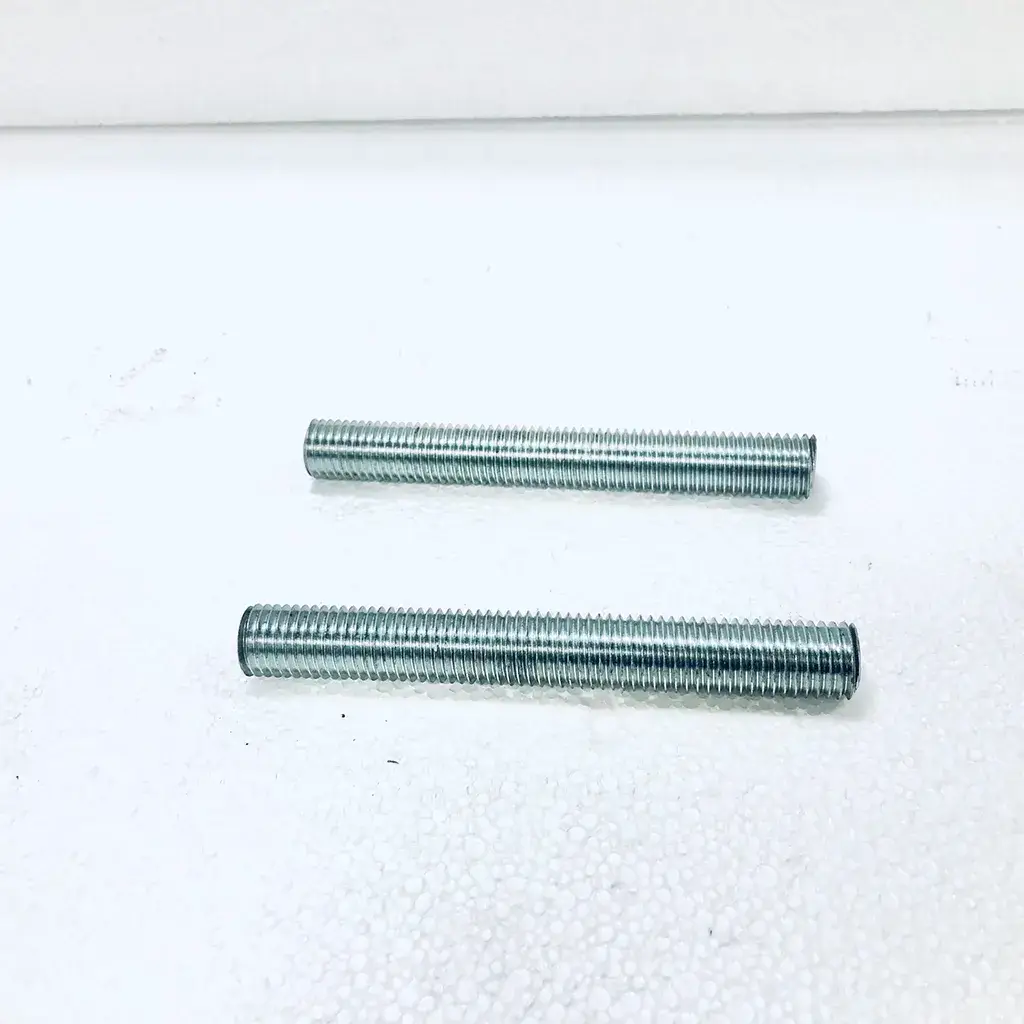
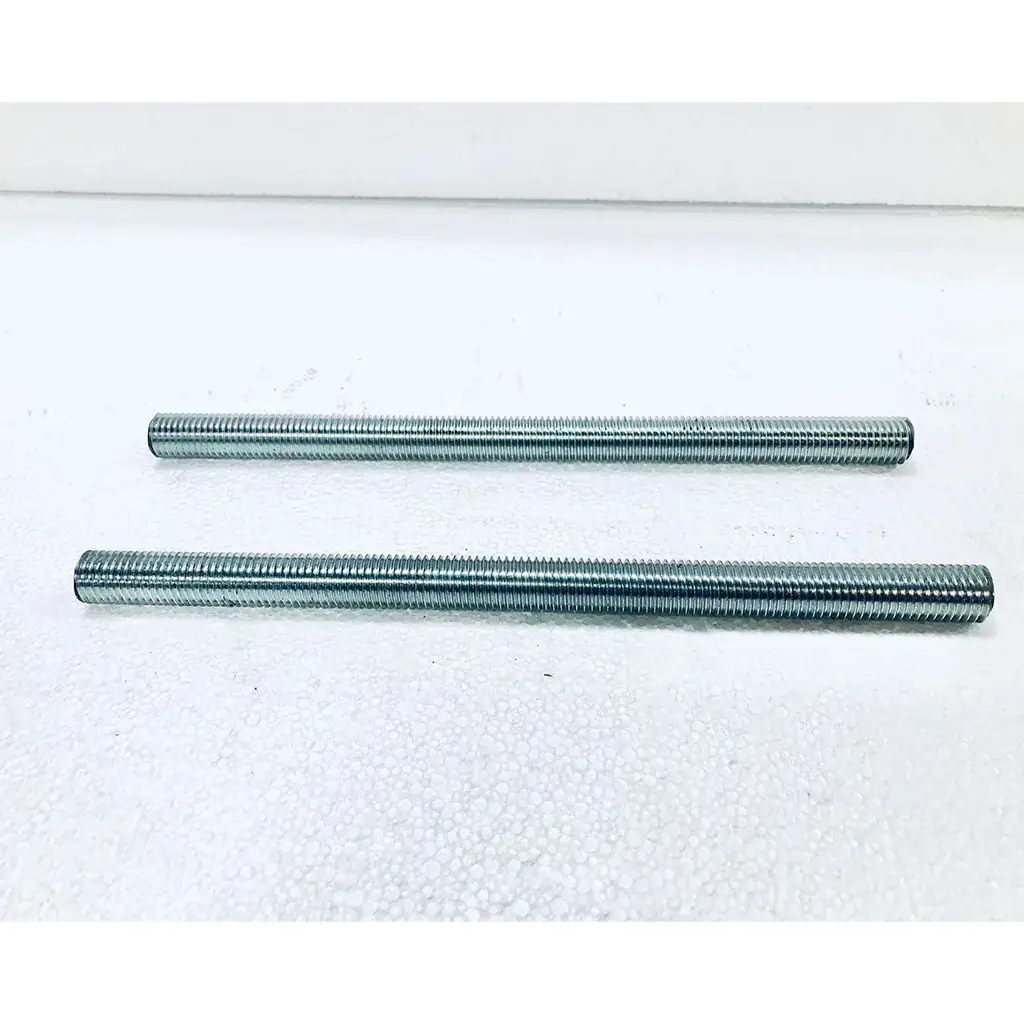
G: 0.75” (3/4”) dia. threaded rods of 6”, 9”, 12”, and 15” length for selection, to adapt with different forklift mounting pin depth
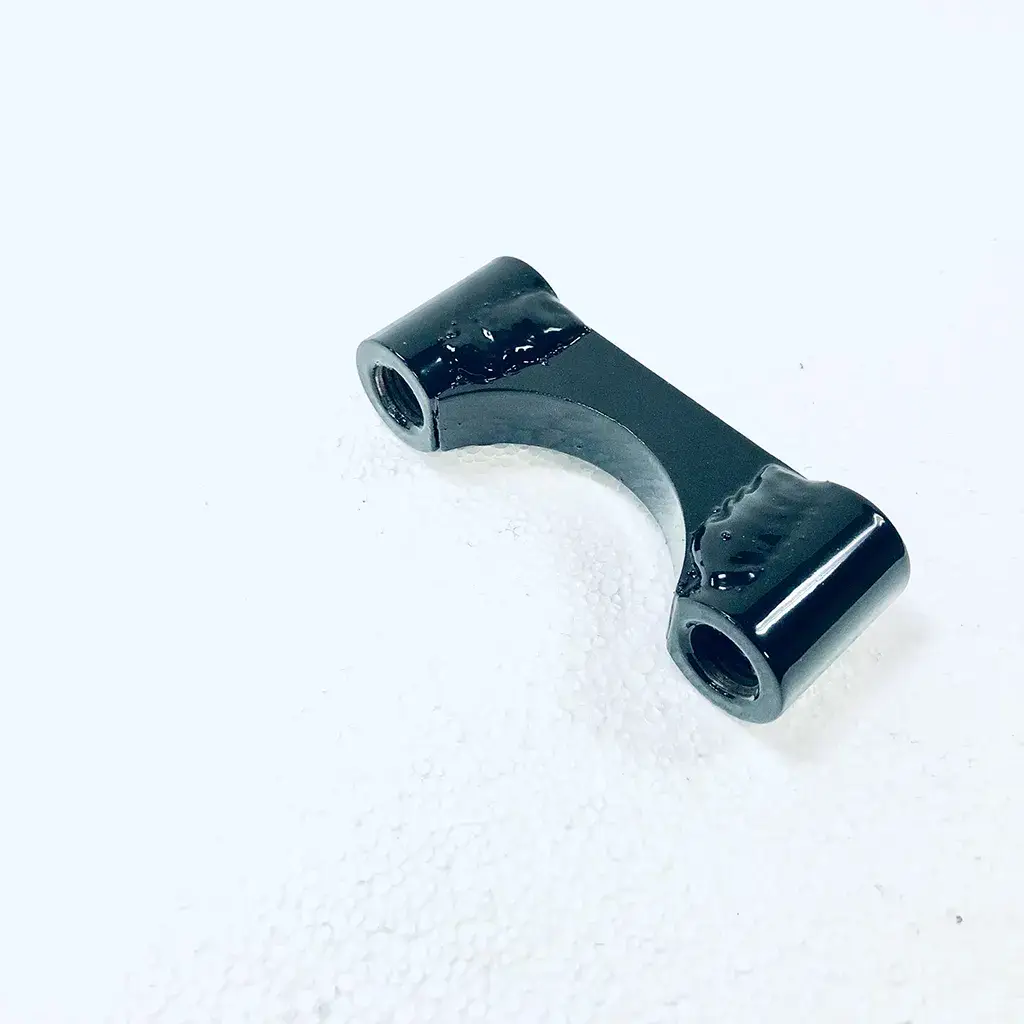
H: 1.25” (1 ¼”) thick steel machined pin hook
I: 0.375” (3/8”) thick steel vented mounting bracket w/ welded reinforcement braces
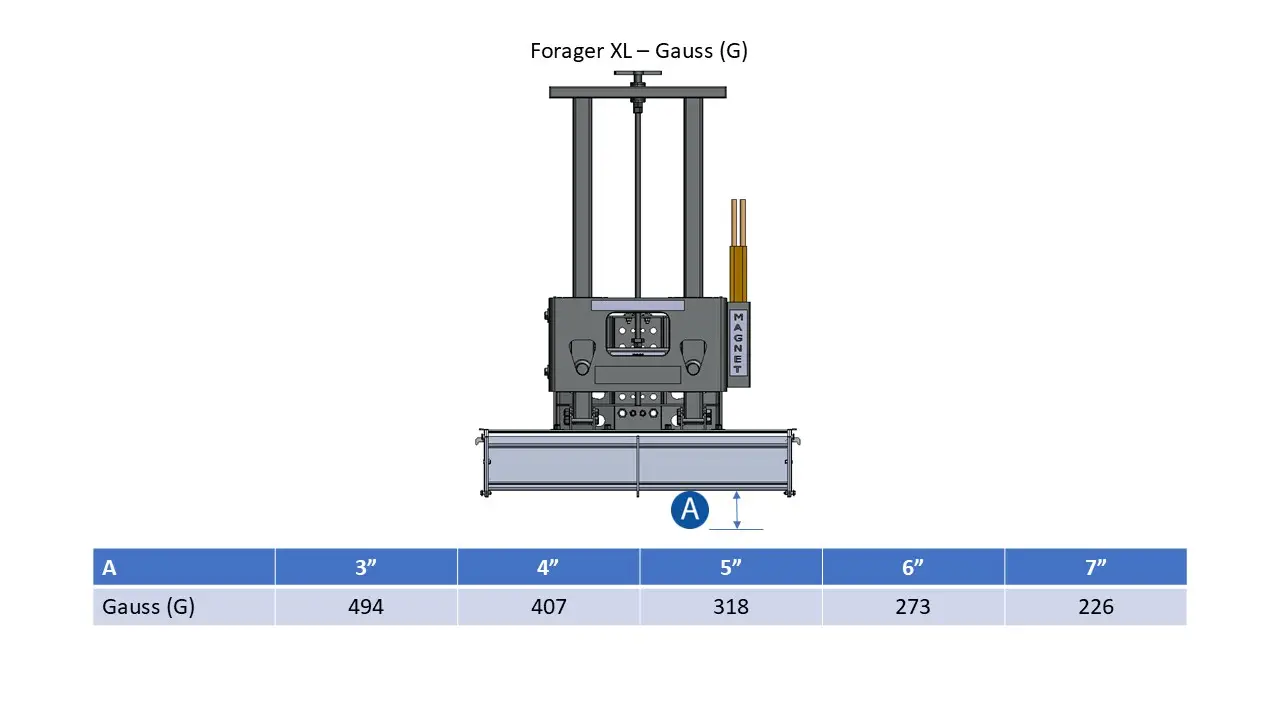
A: A = Distance from Magnet (Sweeping Height)
Note: Gauss (G) shown as the peak gauss measured from the aluminum sleeve’s surface at each distance (sweeping height).
| 5 star | 0% | |
| 4 star | 0% | |
| 3 star | 0% | |
| 2 star | 0% | |
| 1 star | 0% |
Sorry, no reviews match your current selections
$392.37 – $450.77Price range: $392.37 through $450.77
Some industrial processes generate metal debris continuously. The Midwest Gate and Fence Company in Iowa has trucks coming in daily with fences that have been taken down, leaving waste fence wire clippings all over the yard. Cleaning this material up is an ongoing job that can be accomplished by using a rear mounted forklift magnet. Mounting a magnet on the rear of the forklift lets the lift truck go about its normal duties without being impeded while also collecting metal and preventing damage to vehicles and personnel on site.
We were just talking to Richard, and he had this thing packed with—he said that was just from today, that pile there.
Yeah, there’s been a lot. That’s a good thing you got it then.
Yeah, the first couple days, really.
So is that just from, like, just cutting up the chain links, or is it like pallets, that sort of stuff?
It’s them coming back and cleaning their trucks off.
Oh, okay, so like after delivery, they just sweep it all in the yard?
Yeah, so yeah, a bunch of our cut-up ties.
Yeah. If you look on this corner over here, that’s where Richard said he dinged it into a rock pile or something.
Okay, so he thought it was stuck on there, but I think he just had like a nail stuck in between the sleeve and the magnet itself, so it was like just hard to pull off. But we pulled it off the other way, it was fine.
Okay, so it’s still sturdy, but now we have to set up the swing so you’re less likely to break it.
Okay. How hard was this thing to install on here?
I didn’t do it. I can get the people that did it, but I mean, I think it showed up at 3 and it was on probably like 4:30, so an hour and a half install probably.
Yeah, probably would say an hour. I came here, but Richard said he’s pretty happy with this thing so far. Like it’s worked out—cutting down on flats and that sort of thing out here.
Yep.
So were you getting them regularly, like on this thing, or just, you know, once in a blue moon?
No, we’d get them. Trucks every so often, trailers, skid loaders, yeah.
It sucks getting a skid steer down. Those are tough to change. I was thinking, like, this is your only lift you have here, right? Like the main one?
No, there’s some other ones. Yeah, like you have the boom one I saw there.
Yeah, there’s a couple boom ones, but—
So if this thing goes down, it slows everything down around here.
Yep. Yeah, it’s not even just like—
So I guess you probably plug these things; you don’t have to replace them all the time just from a puncture?
It usually breaks a rim.
Really?
Oh, I guess, yeah, once the tire pops, goes down on the rim, usually it’s a rim issue and they’re hard to find.
Really? I never even thought of that.
Yeah, that sucks. When you get a flat, you had to change the rim on it?
No, it was down, sitting right here for probably a month and a half trying to get some rims custom made for it.
Holy, you had to get them cut? Weird size?
Yeah, and there was only one and it was in some other country.
Well, it is—yeah, it’s a weird bolt pattern and the giant hub, right? That’s probably the issue.
It’s a goofy one, yeah.
Richard was saying that you guys just cleaned it off this morning and we already got that much of a pile. I mean, this stuff can easily puncture that tire.
Oh, yeah, and we’ve even got some of these bolts in tires. Bigger bolts, yeah, this carriage bolt here. Yeah, this thing’s—no, it’s working good.
Yeah.
Yeah, I was showing in the one video how it really changes the angle. Like, you can’t back up into the steep hills anymore, but you guys are pretty flat out here.
We’re pretty flat and he just had to get used to it.
Yeah, and I think he’s used to it now.
Yeah, that makes sense.
This thing we showed—like, have you seen the—so these can go up if you really bottom it out. This will go up about two inches, so that’s why I had him get the boom truck out there and he lifted it up, so if you really, really, really beat it out, it’ll go up about two inches and swing out of the way so you don’t break anything.
But yeah, so he said you’re—so how often do you guys clean it off?
Well, the first couple days, it was every day, yeah, for probably a week. And now it’s, she’s probably getting about three, four days.
Yeah, so that—like, how much normally comes off then, you would just say?
Quite a bit. Uh, it’s getting better. It’s definitely getting better.
Yeah, but first couple days, you’d pull it off and it’d be full.
That’s what I was saying to Richard too, is like, it should get better over time, right? As you go around, you shouldn’t have as much, but you’ll still get the regular stuff, right, ‘cause guys are coming in every day, jumping down. That’s kind of the point of these things is, you know, you just had a problem yard, you rent something and do it, but if it’s continuously forming, then this is a nice proactive way to do it.
Yep.
Like Richard was saying, you guys had the fork-mounted one before.
Yep.
And that didn’t—
Yeah, the problem with that too is you can’t use the forklift, and then you gotta be sitting there adjusting it the whole time, and yeah. So with this thing, you just leave it on while the forklift works and it does the whole job for you.
No, we’re happy with it. It’s made a difference for sure.
Yeah, that’s good. Looks about the right size for this thing.
Yeah, you’ve seen the other ones we have; they’re about this big, like half the size, almost. The biggest one you—yeah, the biggest one we had until this one.
But any other companies out there that make magnets, they only sell stuff that’s about an inch tall, and like, trying to stick that on this thing, you’re not doing anything with it.
Oh, yeah.
Like, you know, you have to—that’s what that fork one was, was only—you know, going to do, especially if you’re not driving, like you have to go half a mile an hour.
Yep. This thing’s got enough juice where you can, you know, yeah, go quick and it’ll still pick it up.
Yeah, I’m glad you guys are happy with it. Came with the right price tag.
Yeah, even—I mean, it’s well worth it. Yeah, I mean, ‘cause if that thing goes down—price, and we sell the replacement parts, so if you guys do actually break the sleeve someday—but they’re pretty damn sturdy. But it is, you know, a 30,000-lb thing backing into an immovable object. Something’s got to give.
I’m sure we’ll, you know, dent it up eventually. Everybody does eventually. We had a smaller version of this thing—the four and a half by four and a half sleeve—and to test it, I ran it over with a tractor, and no problem.
Really?
Yeah, they’re pretty damn sturdy, especially ‘cause inside of yours, it’s just pure ceramic, so it’s hard as a rock. It won’t crush as well.
Anyways, but have you guys ever adjusted it up and down at all?
We haven’t. We put it on and that’s where it’s been.
Perfect. That’s what you want.
And it’s working, so—
Yeah, I’m guessing that’s about the height. Yeah, I think we recommend, like, three to six, and that’s about six, so close enough.
Yeah, we could go a little lower; you don’t really need to, as long as it’s still picking up stuff.
Oh, yeah, if you notice the difference—getting less flats, doing its job, right? So that seems to be pretty good then.
But yeah, you guys don’t have too much terrain out here, so—but Richard, it’s not—these are just cut off from the fence, right?
Yep, like disconnecting the links. So if we go doing repairs, they’ll cut the links and it’ll be a bunch of them. Yeah, and then they’ll throw them on the truck and instead of cleaning their truck off like they’re supposed to, yeah, ends up in the yard, they’ll throw it on the ground.
Now you got something to pick it up with and we’ll leave you a nice little pile of crap here to do something with.
Oh, that’s fine.
But yeah, I think that’s all we do. Now we got your pivot set up. I don’t know what you want to do with the bullets; like, we just stuck them up here, and the wrenches are up here.
Okay. We can probably leave those out.
Yeah.
Yeah, there’s no real need to keep ‘em in at all.
Yeah, that thing, you’ll just free it up, even when he’s back into that pile back there, like, the thing just moves so effortless.
Okay.
Yeah, thing’s got way more of get to it.
Yeah, that’ll help with any damage, sort of thing.
Yep, no, we’ll leave it like that. That’s good. I think that’s—

A: Height adjustment locking wing nut locks sweeping height
B: Guiding studs with triangular slots allows for vertical and horizontal movement if the magnet hits the ground to prevent damage
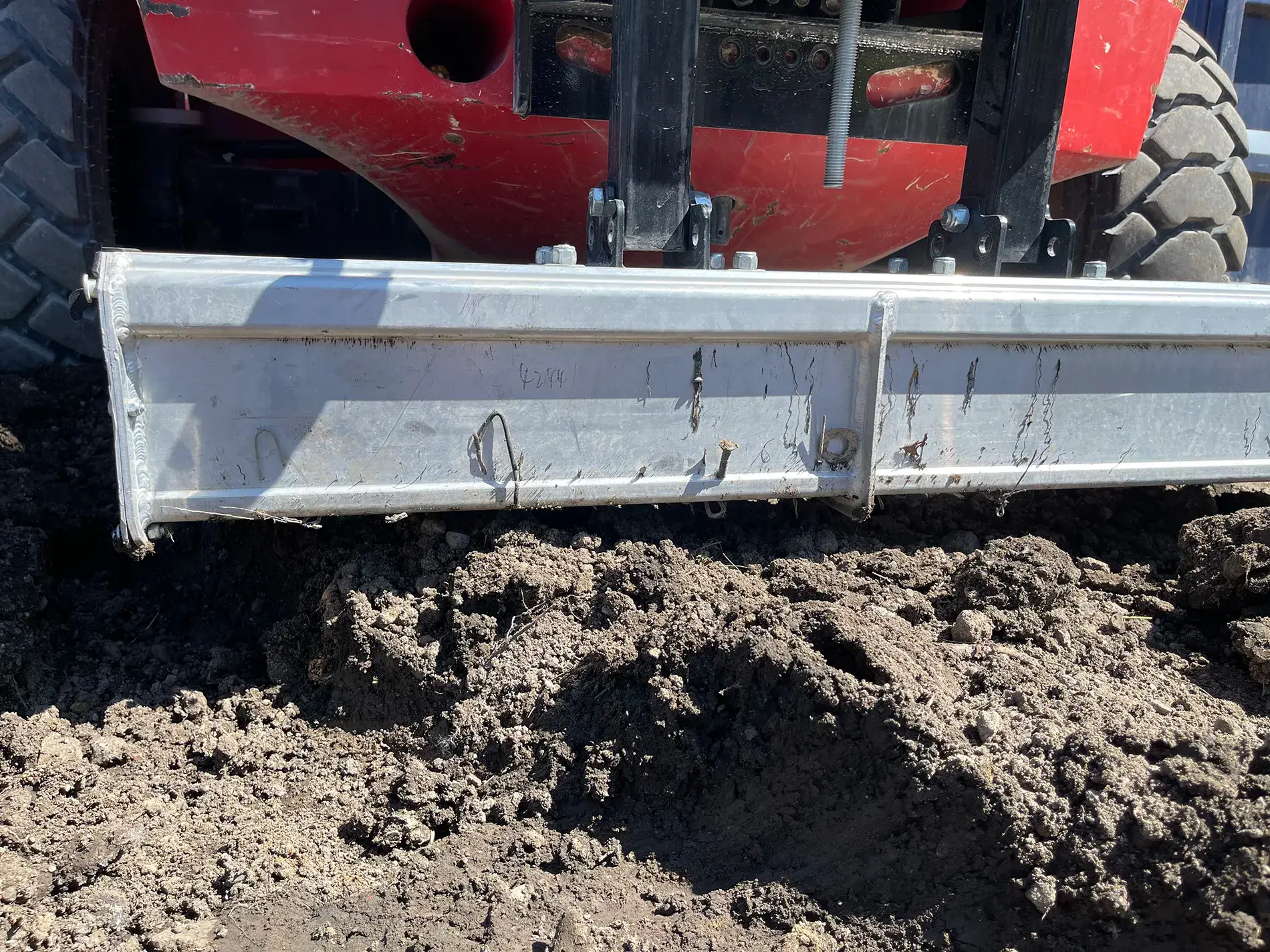
The Forager XL Heavy Duty Forklift Magnet has a powerful C8 ceramic magnet assembly that collects metal debris like nails, bolts, wire, rebar, and staples quickly so the surface area of the magnet can fill up fast. The holding power of the Forager XL’s magnet has the power to pull the debris into the magnet hard enough to press a standard plastic quick clean off sleeve into the aluminum housing making removal difficult due to friction. This is why the Forager XL’s extra magnetic power compared to the original Forager necessitates an aluminum quick clean off sleeve that won’t deform from the pressure of collected debris getting pressed into the magnet housing. The Forager XL cleans off easily and smoothly thanks to plastic inner rails that reduce friction and add space between the sleeve and housing to prevent hangups. A poly fabric debris catcher is included to catch debris that falls off the aluminum quick clean off sleeve.
After driving around with the new Forager XL on the back of this big old forklift, we actually did manage to pick up some metal. So, it looks like, to me, just nails and staples and that sort of thing—a little bit of slag—because this is a welding shop. But this is a good opportunity to show you how to clean the thing off. It comes with this beautiful orange flag, which is supposed to catch any debris you pick up so you don’t have to hand-handle it; you can kind of just throw it in the dumpster. We’ll see how that works, but that’s going to go right under here.
So, this has our new aluminum clean-off sleeve. The design is basically the same as with the Nyx and Erebus, and so it’s got two steel—what would you call them—latches, basically, that sit on either side of the sleeve, preventing it from going back and forth. And to clean the magnet off, you’ve got to make sure you remove those. So, you’ve got the one on this side—it just pops right off, and they’re nice and powder-coated, so you can throw them on the ground and they shouldn’t scratch. And then there’s another one on this side. So this one—they both have hooks—but they have hooks here that retain this stainless steel handle, and the handle is just there so you don’t have to bend over the whole time you’re cleaning off, like I’m bending over now. But when I pull the handle out, you can kind of stand up and walk away.
So, this is the aluminum sleeve, and we previously had problems with the plastic ones crushing in when they collected a lot of metal, so we—this being a much more powerful magnet than our normal 4.5×4/2, where that was a problem—decided this one’s got to have the aluminum sleeve on it. So, the aluminum just prevents the debris on the outside from crushing the sleeve in towards the magnet, which creates friction and makes it hard to pull off. You know, aluminum on aluminum would cause some friction, but this one has ABS on the corners just as bushings, so it slides off nice.
I’ll pop the stainless steel handle out, and then that allows you to stand up, and then you just pull the sleeve and you can see the big ridges on the sleeve itself pull the debris evenly with the magnet. So once that’s off, you can just pop it out, and there’s two ways to do this. We’ve generally found that leaving the sleeve on this far and then just taking the debris off by hand is usually the easiest, because a lot of the time it’ll just flip back around to the magnet. Or you can just pull it all the way off, and it should drop on the flag, which some of it did, but then it immediately got picked back up by the magnet.
So there’s our debris collected. I’ll just put that over there so it doesn’t stick back on the magnet, and that lets me get in a little bit closer with the sleeve. Like I said, this is all aluminum on the sides—it’s 3/16 on the bottom, it’s 8 in—and these are ABS rails on the inside that just glide on the actual magnet housing to prevent friction. And here’s the ridges—so these ridges prevent all of the debris from accumulating on one side and make it slide off more evenly, just so you get less popping back around when you’ve got a big collection on there.
So that is only from maybe ten minutes of sweeping. But if you’re doing this on a whole shift, you’d probably get a lot more over a larger area, because generally your forklift is traveling wherever there’s work being done, and wherever there’s work being done, usually there’s metal debris being created. So over a shift it’s going to probably accumulate a lot more, and then the ridges will help you pull them off evenly without having it all pop over.
So once you’ve got everything cleaned off, just assemble it in reverse order. So just slide her back on. These can be a little tricky just because they’re steel, so they actually magnetize to the magnet as you’re doing it, so you want to just kind of line them up, pop them on, and they retain themselves on there. And this stainless steel handle does come out sometimes if you reach too far up with it, but it just pops back in; it’s pretty simple. Slide that bad boy back on there, and then the key when you’re assembling this side is, this steel latch has to go behind the handle assembly, and there are little hooks in there to make it hold the handle assembly in place as well.
So, that’s it all back together. That’s the clean-off cycle of the Forager XL—pretty straightforward. Like I said, the aluminum sleeve has a lot of advantages over the plastic one, because the plastic one, you know, it can obviously break a lot easier. If you ding this one off the ground a couple times, it should be okay—even on the back of a giant forklift like this. It’s really sturdy aluminum, so it shouldn’t be a problem. And also, the plastic ones tend to crush against the magnet itself—it’s just the pressure of the collected metal debris trying to pull itself towards the magnet squeezes the plastic sleeve against the magnet and creates friction. That doesn’t happen with the aluminum, because it’s not strong enough to bend that aluminum. The pressure of the collected debris pulling against the magnet isn’t strong enough to bend that aluminum. And it just looks a lot nicer.
So, on this beautiful windy February day in Ontario, here’s the new Forager XL. Get it wherever any Forager XLs are.
The Forager XL Forklift Magnet has the magnetic power, ground strike protection and adaptability to most forklifts that allow it to work in any terrain you are operating a high capacity or 4×4 forklift in. Whether operating in a shipping terminal or a rutted precast yard the Forager XL can perform better than any other forklift magnet on the market.
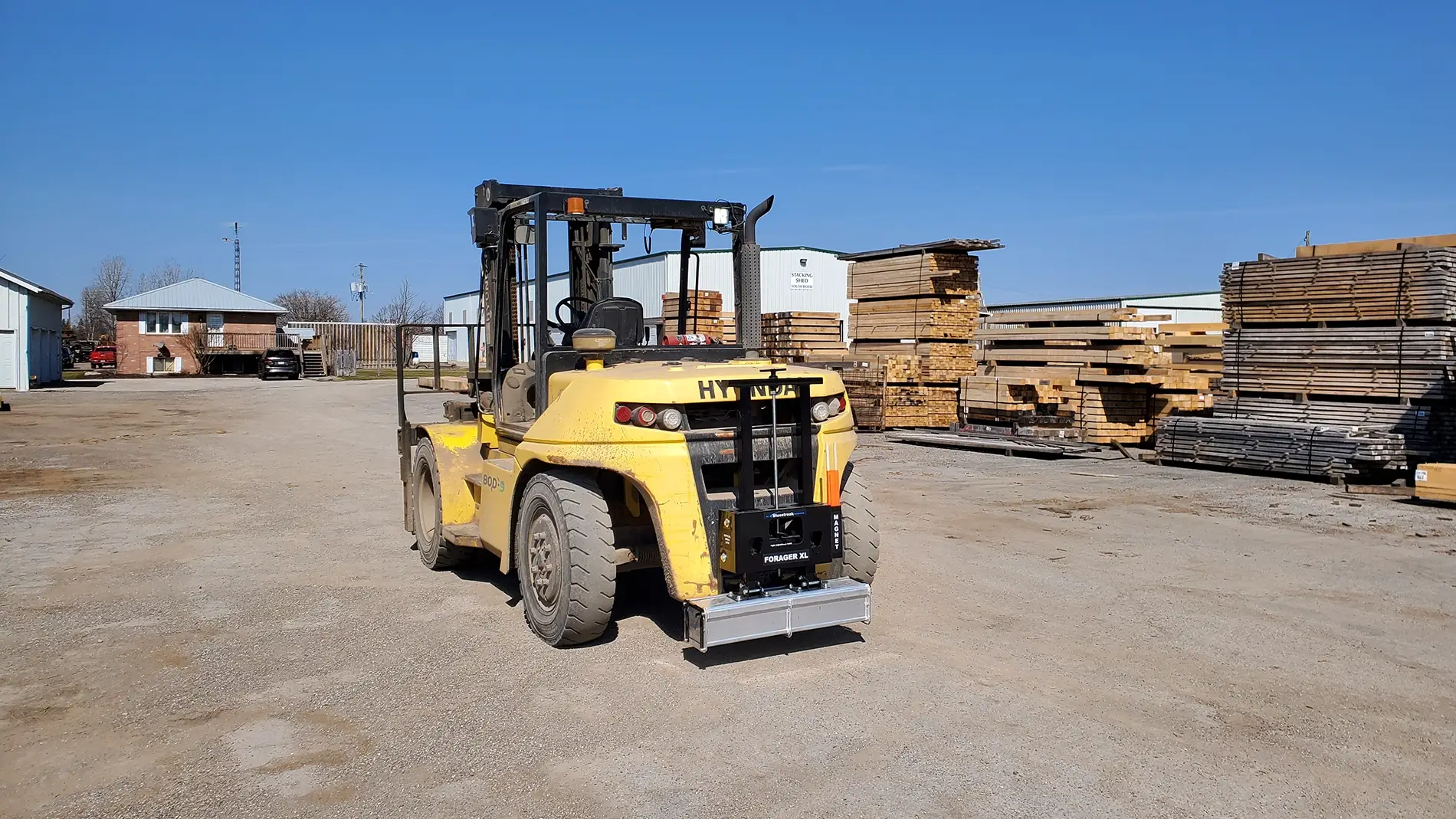
So this is the new Forager XL on the back of this Hyundai forklift down at the lumber yard, and you’ll see we’ve got this thing mounted on the back of this forklift. It’s about 5 and 1/2 inches off the ground, and we’ve got one of the bolts removed on the back so that it can pivot as the operator’s driving here, and that’ll give us a little more motion in case we hit anything on the ground.
So like I said in all the other videos, this thing is just a bigger model—basically the same thing as our original Forager series, but it’s just slightly bigger. So it looks at home on the back of the forklift like this.
We’ve been working with this lumber yard for quite a while. Over the years, they’ve purchased some bar magnets from us to hang off stuff around the yard, a couple of separators, that sort of thing, and one of the complaints that they had was they couldn’t hang the magnets high enough off the ground to be able to clear those spacers that are in between the stacks of wood. That’s critical because these things are all over the ground here, and while this forklift is driving around, it’s going to need to run over those things without bottoming out the magnet or the forklift.
So you can see that thing’s on the back of the forklift. We’ve got it set up, like I said, about 5 inches off the ground, and that’s a 39-inch model that looks just about right on the back of this Hyundai. Sometimes guys want it to overlap over the wheels on the back; sometimes they don’t, so this seems to be about the right length for the counterweight.
These guys don’t necessarily have a lot of metal debris problems around here because everything’s wood, but they do say there’s sometimes some banding laying around. We’ve been down here before with another magnetic sweeper and picked up a couple nails—not too bad, but when you have a forklift like this running around anyway doing whatever it needs to do, it’s a very proactive way to stay ahead of flat tires just by having this thing hooked up all the time to be able to clean while the forklift’s running.
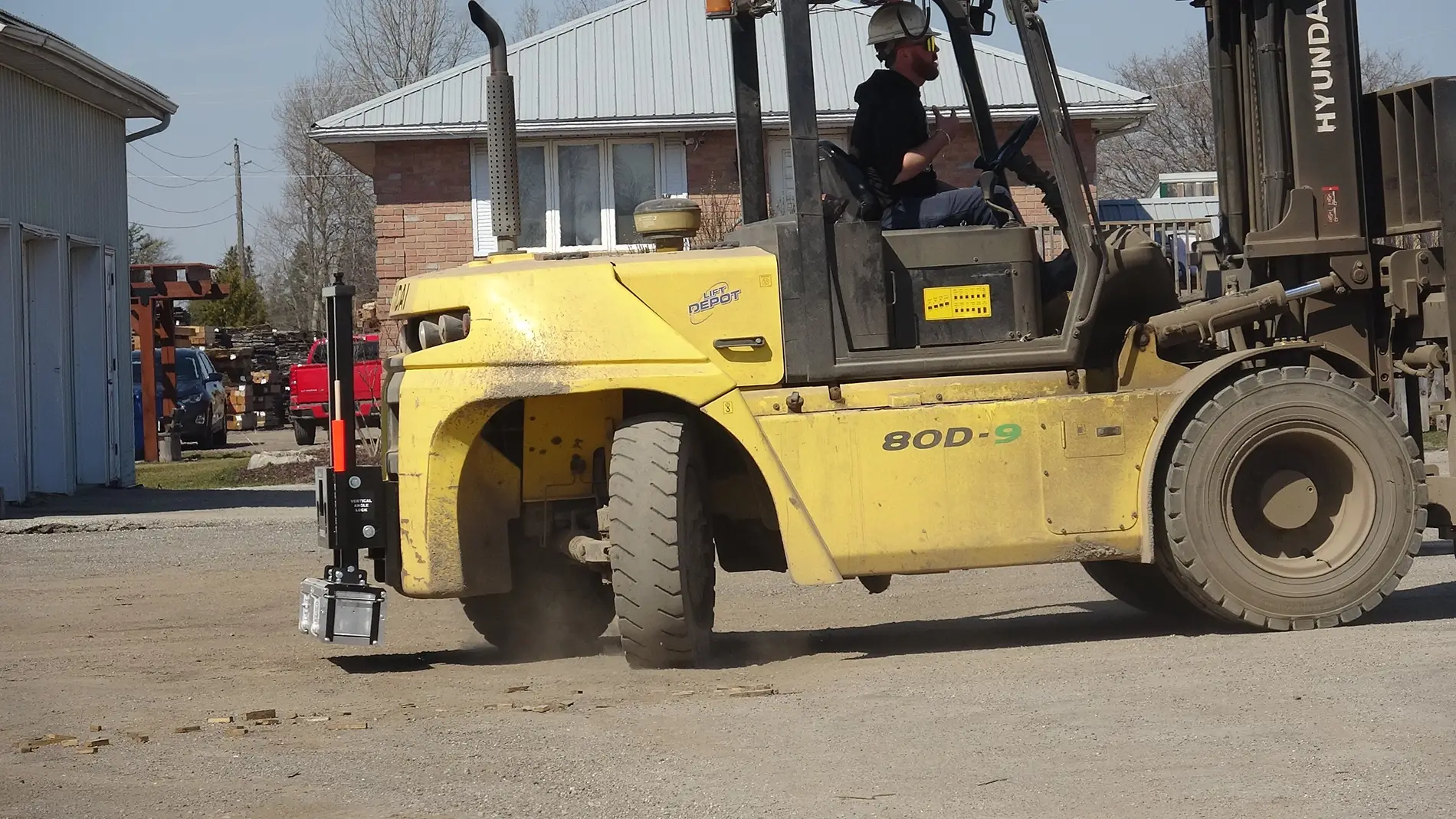
You’ll see when he stops here, the magnet’s going to swing as we pulled out the front, which allows the magnet to swing backwards as he’s driving around. So this magnet is rated at a 12-inch maximum pickup height, which means it’ll pick up a 2 and 1/2 inch nail from 12 inches, or a foot off the ground. So that’s why it’s perfectly fine to have this thing mounted even 5 or 6 inches off the ground, because it’s got enough power to collect any type of metal debris even while the forklift’s moving around.
You can see the ground clearance on this forklift is pretty high. It looks like the running boards are about a foot off the ground, so you don’t want to limit that too much by putting a magnet on your forklift. You don’t want to eliminate any capability it might have, so that’s why this thing is such a strong magnet—because it’s designed to hang off the ground quite a ways up without limiting the ground clearance of your forklift too bad.
You’ll see it’s about 5 inches off the ground; everything else is about a foot, but that’s a good way to still ensure good pickup height and good metal debris collection without sacrificing too much ground.
To ensure a long service life, the Forager XL is packed with features that prevent catastrophic damage to the sweeper and forklift if the magnet is bottomed out. The magnet housing can pivot away from impacts while travelling either direction which redirects force from the impact into the swinging motion of the magnet assembly rather than into the sweeper frame. If in extremely rough terrain with large drop offs or obstacles, the Forager XL magnet assembly can move 3” up if impacted from below. These functions coupled with the impact / abrasion resistant aluminum quick clean off sleeve ensure the Forager XL will have a long service life even in the toughest situations. These videos show the pivoting and bottom out protection features in action.
And you see there, it just looked like the pivot function took up all of that impact. So, we have the one bolt removed so the magnet can slide out, and it’s doing its job perfectly, protecting the aluminum sleeve without—uh, didn’t really need that upward motion at all.
All right, so here’s take two. We’re going to hit it with just a little more heat and see what happens. Just watch that magnet go up. There you go.
That’s just a little bit of the durability testing. So, obviously, you’re never going to have your magnet actually set this low. This is just for extreme use testing. But if you are running over big obstacles and you’ve got big pull, you don’t have to worry too much because the magnet has lots of protection features to keep it safe, even if you’re running over big—
Okay, here’s more durability testing on the Forager. We’re going to go off this little drop in the gravel here and see if we can get the magnet to use its 2 inches of jumping height. Yeah, there you go. You see those pins move up in the slot there. That’s good. They’re in case you really bottom it out like that, so the magnet goes up and doesn’t rip it off the back of your forklift.
Putting a magnetic sweeper on a forklift will always lower the offroad capabilities of the forklift. The Manitou forklift was designed to work in tougher terrains, with that in mind the Forager XL was created to be able to collect metal debris while set at higher sweeping heights and has provisions to allow for travelling in tough terrains without damaging the magnet itself from bottoming out. Check out the following videos for further explanations of the Forager XL ‘s provisions for surviving bottom outs and hits. The Forager XL is perfect for running in yards that may have potholes or obstacles that require setting the magnet higher off the ground for the sake of ground clearance.
So one of the concerns of putting a magnet on the back of your forklift, especially a unit like this with off-road focused tires and all the ground clearance, is you’re going to lose a lot of capability of driving through rougher terrain. Now, this yard doesn’t really have too rough terrain because they level it out quite often with the box grader that’s running in the background, but we’re just going to show you, using this big pipe, the approach angle that you would normally have on a forklift versus what happens once you stick a magnet on it.
So your approach angle is measured by the back of the tire to the bumper. This is your typical angle; you could theoretically back up a hill in this Manitou forklift and still be able to go up it. Now, with the Forager on it, it’s going to be measured from the back of the tire to the lowest point of the magnet, which is here, so that’s quite a difference—you’re losing quite a bit there.
But because the Forager XL has the swinging capability and also is able to come up, you get some of that angle back. It’s still a compromise, but you’re compromising between having flat tires versus not, and how much off-road capability you need. So that’s why, in this place—not too rough a terrain—it makes sense to have the magnet on the back, but you don’t lose all of your off-road capability because as this thing swings—so, Em, if you want to follow the pipe with the angle of the magnet—so this thing will swing up. You get a little bit of clearance back with it.
So we’ll do that one more time; we’ll swing it up here. Here you get another couple inches, raising that angle up, and that works both ways; it swings either way on the forklift, so forward and backward you get the same approach angle.
So we’ve used this other forklift to simulate what I like to call the jump function. It’s essentially if you really bottom this thing out hard, like hopping off a curb or a sharp drop-off, there’s provisions in the Forager XL to move up about 2 and 1/2 inches. That’s accomplished using the pins that are in the mounting system that go to the forklift—I’ve shown that in a different video but I’ll probably cut to it here—and you can see in the mounting system to the forklift here, there are those pins. That’s basically what all the weight of the Forager XL rides on—are those two pins—and the triangular slots there allow it to go up and down.
So we have it jacked up right now, just with another lift here, and that gets you some more ground clearance. Now, you’re not going to be picking up metal from this high—it’s way too high—but it’s there, so if you are driving around in really rough conditions, you’ll get that extra ground clearance you want.
But as you can see, once it’s jacked up like this—if you want to measure the angle there—it’s a little bit taller, so you get some of your approach angle back as it goes up, and then it will also pivot from this point. So you do compromise some off-road capability using the Forager XL, but it’s designed in a way to make it as minimal as possible while still being able to collect debris.
So this thing will pick up a nail from, I think, 12 inches, and they have it set at about 6 inches, so you’ve got 6 inches of ground clearance to work with, which is more than any other magnetic sweeper on the market. And then you also have these provisions built in to swing and jump, so if you really do drive around in the rough stuff like this Manitou is meant for, you’re not losing too much capability by having the magnet on the back, and then you’re still getting the benefit of collecting any metal that might be out there.
So I’ll take the back bolts off, I’ll show it pivoting forward, yeah, and then I’ll take—the, I’ll start with these ones, yeah, and then it’ll pivot back, then these ones, and pivot forward. Okay, sounds good.
Emmett—so Emmett’s going to pop the bolts out of this back of the Forager XL here. So these bolts are both installed from the factory, but they don’t actually need to be there. They are there so if you don’t have the clearance between your forklift and the Forager XL, it won’t swing. But this Manitou has a ton of clearance, so we’re going to pop them both out because this guy was saying he was running into stuff backing up. So we’ll pop both the bolts out so the thing can swing forward and backwards easily, and that’ll prevent any further damage to the magnet. Looks like they hit something pretty good on the other side already—there’s a bend in the sleeve—but taking these bolts out will prevent any additional damage.
Looks like they hit something pretty good. That’s just from backing up—stuff, backing it up into ruts and mounds in the yard. So we’re going to pop these bolts out so the thing can swing freely, and that’ll probably prevent some damage in the future going forward.
So now we’ve got both the bolts popped out on each of the hangers. So, Emmett, you’ll give it a kick. You see it pivots forward and backwards there, so that’s going to prevent a lot of damage if you ever hit anything moving forwards or backwards, because the magnet will just swing out of the way rather than be held on by those big ass bolts and probably causing damage to the sleeve if you hit something. Because it’s not rigid anymore, it can now move out of the way, distribute the force into momentum rather than bending the aluminum.
So this is just an example of the swinging motion so you can see it swings up and out of the way, and that prevents any damage to the magnet. You’re not going to lose any debris even if you do this, because you can see there’s some stuff stuck on the front of the magnet. That’s because of the wraparound function. So if you hit it forward or backwards with debris—the magnet gets hit forward or backwards with the ground—it’ll still stick on the magnet.
So now we’ve got that pivot function out of the way, you’re less likely to break anything. If you watch, he goes forwards, it’ll pivot hitting something else, and then return back to center. So that prevents a lot of damage to the magnet housing and the aluminum sleeve. Now, the aluminum sleeve is really heavy duty, but with a giant machine like this, you’re capable of doing a lot of damage, so that’s why we’ve got that swinging function and also the jump function, as you saw in some of the other videos on this page. So it’ll jump up and out of the way if you need to as well.
The Forager XL Heavy Duty Rear Mounted Forklift Magnet is packed with features to perform in the toughest conditions on big forklifts. The massive 7×7” ceramic magnet assembly can pick up metal debris while mounted high enough to avoid hits in rough terrain. If the magnet does touch down, the wrap around function will keep all collected debris stuck on the magnet. The magnet assembly can swing fore and aft and jump up and out of the way of obstructions if hit to prevent damage. Check out an overview of the Forager XL’s features with a comparison to the original Forager forklift magnet in this video.
The new Forager XL is very much like the Forager normal, except it’s extra large. So with the Forager XL, you get our new 7×7 magnet assembly as opposed to the original Forager’s 4 1/2 x 4 1/2 assembly. Now, previously, according to everything else on the market, 4 1/2 x 4 1/2 is a lot bigger than anything else you can buy from any of our competitors, so that’s already the biggest offered on the market. But if you look at the two forklifts behind me, it looks perfectly fine on this little 6,600 lb Toyota. This is a normal forklift—this is what everybody has around. But there are people out there with big monsters like this. So, this is a 14,000 lb forklift, and if you stuck that little original Forager on here, it would look just dinky. It’s not going to look great, and when you tend to have a bigger forklift like this you tend to work on harsher terrain, rougher conditions, so you kind of want to mount the magnet a little bit higher. So that’s where the 7×7 comes from. So, this magnet here will pick up a nail from 12 in—we just tested yesterday. So if you hang the bottom of this sleeve 12 in off the ground, it’ll pick up a 2 1/2 in nail. So you can, you know, have it set at 4 to 6 in sweeping height, which is plenty of ground clearance for any forklift. And then we’ve got the original Forager, which picks up a nail from 8 1/2 in, so you have to hang it a little bit lower. I think we recommend, you know, 1 to 4 in, somewhere around there. So you can really jack this thing way up off the ground and still collect a lot of debris.
But essentially, it is the same unit. It’s not the exact same in appearance, as there are some modifications we had to do to make it work to accommodate for the bigger size, but it essentially has all the same features as the original Forager. So, with that, you get your adjustable height, which is just a little screw jack type deal. You’ve got your impact protection with the aluminum sleeve. It swings, so if you hit something going this way it’ll swing out—or you can set it to go the other way, or both. So it’ll swing either way if you hit things, and it’s got this kind of a jump mechanism type thing. So if you really bottom out on something, it’ll just jack it up and then it’ll come back down, rather than ripping it off the back of your forklift.
The reason for this thing, like I said before, is just bigger and badder forklifts people come out with. They say, “Hey, we need something strong. We’re in a really rough yard, we need to be able to pick up nails, we’re getting flats,” that sort of thing, and they wanted something bigger than the Forager—yeah, the original Forager. So that’s why we’ve got the new Forager XL. Couple main standouts compared to the original is obviously the size. So I’m about 6’2″ and this thing is up to my chest when it’s on the back. If it’s on the ground, it’s about here. This thing looks like half the size. So this whole unit, this is a 31 in model, it weighs 430 lb just about, and this thing weighs just about 135 lb. So that’s your difference and they’re both similar width—that’s a 32 in Forager original, 31 in Forager XL, and it’s a 300 lb difference. So that just accounts for bigger steel, way more magnet, and everything’s got to be reinforced. When you go bigger, everything’s got to get thicker.
So this is going to be probably a little bit overkill for most normal forklifts—got a little 6,600 lb guy, you’re driving around 5,000 lb forklifts, indoor forklifts, probably a little bit overkill. But if you’ve got something big like this or an outdoor forklift, big off-road forklifts with the four-wheel drive, this is going to be what you want. Like I said, it’ll pick up a nail from 12 in up, so you can set it at 6 in and still have a really effective pickup height and pickup rate of collecting any metal that you’re trying to get. And because it’s such a big magnet, you can use it to pick up really big metal—you don’t have to worry about, you know, missing it ’cause it’s heavy. It’s a really strong magnet, the field around it is huge, and it’s going to pick up all your nails, bolts, wires, springs—whatever you’ve got on the ground, this thing will get. And because you can stick it on such a big outdoor forklift, it’s got some protection to help it if you’re going to be hitting the ground, ’cause obviously this is for rougher terrain, ’cause it’s bigger forklifts, rougher terrain, that sort of thing.
And it comes in—so the Forager XL comes in a couple different widths. This is the 31 in model, but you can get it all the way up to a 47 in, which, you know, depending on your forklift—some people like them past the wheel, some people don’t. It’s up to you and what you need to do: turning radius, that sort of thing. You can just figure that one out for yourself. But yeah, this is the 31 in model; it comes out to 47 if you want a bigger one. So it gives you lots of options for different size forklifts, and this is a big enough magnet for nearly any application. I don’t really know why else you would need something bigger than this for picking up metal debris, but if you have a big, big forklift and you’re operating in rough conditions with lots of potholes and bumps and mud and whatever, this is going to be good.
And another part with the mud is this has a wraparound function, because the magnet is fully packed with ceramic, so if you hit the ground, any nails you collect on the bottom will get wrapped around to the sides of the magnet and it won’t get dropped on the ground. So this is just an ideal one for really heavy-duty applications. The Forager is, like I said before, this was the heaviest-duty forklift magnet—well, rear-mounted forklift magnet—on the market, because nobody sells them this big to begin with, and it’s the only one like it. But now we’ve got the big brother, the XL, for even tougher jobs. So before, when we said this was the best, it was, and probably still is for most cases, but if you’ve got something really heavy-duty, you’ve got a big forklift, you’ve got bad conditions you’re driving in, this is going to be the one you want.
And we just hooked both of these up just to show the comparison. You can obviously see the size difference here, and the size of the magnet’s astonishing. It’s probably a little hard to tell on camera, but this is a big aluminum sleeve, little plastic sleeve—it’s a big, you know, 4 1/2 versus 7×7. It’s a big difference. But we’ve got them both hooked up here, and we’re just going to probably run around and see what we can pick.
A: Forager XL magnet assembly can pivot forwards backwards, or both ways depending on which bolts are removed from pivot assembly.
B: U-Bolts hold the Forager mounting bracket to the rear pin of the forklift.
The Forager XL’s permanently charged ceramic magnet assembly has the capability to pick up a 2.5” inch 8 penny nail from 12” inches off the ground. This pickup power allows the Forager XL to easily collect any type of metal debris while the forklift is moving at the recommended sweeping height of 4-6” inches.
Here’s the pickup height video for the new Forager XL forklift magnetic sweeper. We have the bottom of the aluminum quick clean-off sleeve 12 inches off the concrete here, and we have our two 2 and 1/2 inch 8 penny nails on this piece of cardboard. So I’m going to slide it under, and it should pick them right up.
The Forager XL was designed to mount onto almost any forklift but was specifically built for high capacity and 4×4 forklifts that operate in rougher terrain. The Forager XL features a vented mounting bracket with multiple holes drilled in it to accommodate varying pin heights. This bracket allows exhaust to pass through it in case the forklift it is being mounted on exhausts through the rear pin hole. This bracket hugs the counterweight of the forklift and acts as a mounting point for the rest of the Forager XL. The main Forager XL frame assembly can be tilted towards or away from the counterweight to ensure the magnet is parallel with the ground you are travelling on even if the counterweight isn’t vertical. Height adjustment handles with UHMW bushings allow operators to easily set the sweeping height of the magnet with a jam nut to lock the height. The following video gives more detail on how the mounting and adjustments on the Forager XL work. Check the Fit Guidelines for details on the limits of dimensions a forklift can have and still work with the Forager XL.
New Forager XL Magnetic Sweeper for forklifts. So this is the larger version of our existing Forager, hence the name Forager XL. In this video, I’m just going to go over a couple of the features of it—just pivot points and the mounting system—and give a general overview of how it works.
So, this magnet mounts to a pin, the rear pin on your forklift. Behind this plate here is the back of the forklift, the counterweight, and there’s a U-bolt that you might be able to see if I get close enough here. Those two bolts back there are a U-bolt that goes around the pin of your forklift and secures the mounting plate to the counterweight, so that’s fixed in place. There are multiple holes drilled in this mounting plate to accommodate different height forklift pins, and then from there, that mounts onto our Forager magnet assembly.
This has a couple things holding it on. Number one, gravity—there’s a pin right there you can see going through a hole. That little square piece just secures it in place and doesn’t let it fall out, and then that’s held on also by these two bolts. So, the Forager has a decent amount of adjustability on it. Because the back of the forklift isn’t always flat, we give you these two bolts that allow you to pivot the magnet in or out. You’ve got your pivot bolt on the top there and then the lock bolt on the bottom. Like I said, if both of these are loose, you can move the magnet in or out and then cinch it down where you want it, tighten them both up, and it’ll stay there. That keeps your magnet parallel with the ground so it’s completely flat and level.
On the Forager XL, it might look like we’re missing a bolt here on this piece. So, this is another level of adjustability that allows you to manage the swing of the magnet. When this thing is moving, you have the ability to allow it to fix in place or pivot—allow it to pivot back and forth. If you take out the rear bolt, it will swing away from the forklift but not towards it, and if you take out the front bolt, it’ll swing towards the forklift. If you take them both out, it’ll swing either way. This just depends on what kind of forklift you have. If you want to allow it to swing back and forth, that will allow for the most amount of movement, so if you back into something, it’s less of a harsh impact because it can swing. That’s a benefit, but it’s only useful if your forklift can handle it.
We allowed this one to pivot backwards only, so if you swing it, it’ll swing that way but it won’t swing back. That’s the common way these are set up. Some forklifts allow you to let it swing both ways, but this one doesn’t. That’s one level of impact protection this thing gives you.
Another point is right here. This is black on black—it’s probably pretty hard to see—but inside, you see that giant steel dowel that allows the magnet to shift upwards if it’s suddenly struck from the bottom. This magnet assembly weighs, I think, 300-something pounds, so I’m not going to lift it, but this will move up in this slot so you can move around. If you hit it and it shifts one way or the other, it’ll be okay. Then it drops back down and gets caught here—just another little piece of impact protection for if you’re working on harsher terrain, which often these bigger forklifts do.
And then, of course, your last level of protection—which is probably the first level going to hit the ground—is the new aluminum quick clean-off sleeve. This is 8-inch aluminum on the very bottom, where it’s most likely going to hit, and then 3/16 on the sides. These are really heavy duty. We have them on our smaller hanging magnets as well.
And yep, you’ve got height adjustability also. This locks it off—this is just a lock nut, you just turn it left to unlock, right to lock, pretty easy. All it does is just jam the threaded rod—a threaded rod comes up here to this handle up here—UHMW bushings on it, and you just thread this one way or the other to raise or lower the magnet. We recommend 4 to 6 inches sweeping height. Right now, we have it set at exactly 5 inches.
And that’s your overview of the features and adjustability on the Forager XL. It also comes with a flag so you can use that to drop debris on. We’ll get into that.
Forager XL Magnet on 16,000 Lbs Lift Truck
The Forager XL Rear Mount Forklift Magnet was specifically designed to keep forklifts operating in rougher yards working without having to think about ground clearance. The magnet assembly is strong enough to pick up nails at reasonable sweeping heights that don’t limit the operation of the forklift in the yard because of bottoming out issues. This extra ground clearance and magnetic power makes the Forager XL perfect for proactively collecting debris while your high-capacity forklifts work.
The Forager XL Forklift Magnet is built to withstand harsh terrain and heavy debris contamination. From potholed yards to gravel to farms with mud and ruts, the Forager XL Forklift Magnet can do it all and take the hits. With three protection factors to keep the Forager XL together through the rough stuff, this is a magnet that you can rely on to keep your jobsites clean despite the conditions. Check out this video to see the Forager XL retrieving banding while mounted approximately 6” off the ground.
And we got some banding cut up on the ground here. This is very typical of what you would see on this chop site just because this whole banding is used to hold all the wood together. And, uh, so we’re just going to back over it real quick with this Forager XL, just to show how well it picks it up.
And there’s your debris collection.
All right, so here’s the clean-off of the Forager XL after we just ran it around this lumberyard SL Sawmill. We did throw some banding on the ground just to pick it up, just to show how well the magnet picks up any of the debris that is around, even at this 6-inch sweeping height.
So, to clean it off, just like we said in the other videos, there are clips on either side of the magnet. So these clips just retain the aluminum sleeve; they don’t allow it to move back and forth as you’re driving. And then once you come around to this side, there’s an aluminum or a stainless steel handle that allows you to pull the sleeve off without bending over too far. Because this sleeve is actually pretty heavy—it’s about, I think, 80 lbs—we recommend not pulling it off all the way here, and then you can just get underneath it and pull everything out by hand without cutting yourself.
Now, it’s probably best to wear gloves doing this because there’s actually a lot more than we thought. This isn’t a perfect way to clean something off, but it’s better than just picking it all off by hand.
So it looks like we got just a bunch of wiring—that looks like some staples, some wires that came off of, uh, these are all just like staples, just holding down tarps on these wood piles. And then we obviously got our two wrenches we threw down, and the banding.
So, once this is all cleaned off here—we actually got some on the backside because we were backing over the debris—so once you get this thing cleaned off nicely, we can take a look at our pile and show you what we got.
So, the sleeve, like I said before, slides on and off really smoothly because there are plastic corners on every inner rail of the clean-off sleeve, so you’re not getting aluminum on aluminum. And that allows the thing to move off really easy, just the tips of your fingers, you can move it. And like I said, the sleeve weighs 80 lbs, but because it’s got the plastic rails on the inside, it slides nicely.
So, we’ll just replace the clips we took off. That’s one on one side, and then we’ll pop this one back on the other side, and that’s your full clean-off cycle—minus one piece of banding I forgot to pull off.
So, there’s the debris pile we ended up collecting. Like I said, a lot of this we threw down, but a lot of it we didn’t. There’s a ton of staples in there that we didn’t put down at all. We did put down the wrenches and the banding just to demonstrate how well the magnet picks up, even at this 6-inch sweeping height.
So, there’s your debris from the lumberyard, and then you can see on this side that black thing would be the sleeve retaining clip that I was talking about. And then the aluminum or the stainless steel handle you see here is the handle that extends up so you can pull the mag, or the sleeve, off easier. But these just simply pop on and off; they’re retained by little—uh, I guess you call them grommets—in each corner. So these interface with cutouts in the clip, hold it in place, and make sure your sleeve doesn’t go back and forth and come off on you, because this provides a little bit of lateral force to prevent the sleeve from coming off.
And there is also this, uh, orange plastic thing to catch debris, but we tend not to use it. But it is there in case you want to make sure everything falls onto one little pile and it’s easy to pick up.
A: Poly fabric debris catcher prevents the need to handle metal debris
B: Aluminum Quick Clean Off Sleeve protects magnet assembly and makes clean off easier
Copy
Copy
Copy
Copy
Copy
Copy
Copy
Copy
Copy
Copy
Copy
Copy